I'm sure you've all heard about Cameron's Easter Reception speech (yes, that time he called himself a giant Dyno-rod- what even?) But he said some other things. Things like "Jesus invented the Big Society 2000 years ago, I just want to see more of it and encourage as much of it as possible." Well, I'm no Bible scholar, and I'm probably not the person to do a decent scripture deconstruction of it. Instead, I'm going to look at the three major things Cameron said he cared about in his speech, and how they align up with what things were like in ancient Judeo-Christianity.
If you are interested, you can read the full text of Cameron's speech here.
1. "To expand the role of faith and faith organisations in our country."
I'm going to liberally replace "faith" here with "non-governmental". This is because there was no seperation between faith and state in the ancient world; people working in civil magistracies were the administrators of local law and goverment and also the important people in festivals, performing the sacrifice or saying the prayer, or making the annual dedications. But, basically, Cameron would prefer it if the state did fewer things, and the slack was picked up by people further down. Preferably people he doesn't have to pay.
Good news, Dave! The Roman system is just the model for you! What you do, simply, is take over a place with violence or the threat of violence, and then offer financial or status incentives to the existing elites. Allow them to keep their cushy jobs, as long as they go along with what you say and don't rock the boat. Don't worry about accountability, these kinds of local politics are so obscure we in the modern world know almost nothing about them. If people have a problem they can complain to the governor of the province, or to the emperor (we have papyri archives of people's documents, giving court dates and trial details and contracts. One published example is the Babatha Archive, from Judea.) If you complained to the Emperor, you usually had to do it as a whole city, after which you would engrave both your petition and the emperor's response onto a tablet and proudly display it. Look! The emperor had, for a few glorious minutes, thought about your small town! And he'd tell the governor to do something, and if you were lucky the governor actually would.
In the absence of the internet, high-speed communication or Public Schools producing a particularly viciously patriotic brand of civil servants (looking at you, British Empire), this was how the Romans chose to govern. For the most part, it worked. If you don't mind non-existent public services, a postcode lottery like no other, rampant corruption, nepotism and impossible legal systems.
When Judea was first taken over, they had successive series of client kings and procurators or prefects. The only real difference here was that the client king was from a previous royal familiy (or the Romans had decided he was), and the procurator (or prefect) was a Roman official. Pontius Pilate was the procurator between 26-36 CE. The Biblical story of Pilate is rather relevant here. Famously, he "washes his hands" (Gospel of Matthew) of the Jesus business, and lets the Jewish High Priests do what they want. This nicely epitomises the differences: Pilate is hands-off (literally) and not interested in understanding the intricacies of
Jewish law.
2. "To raise the profile of the persecution of Christians around the world."
If he'd just left that there, I'd have been happy (ish). Religious persectution is bad, as all forms of persecution are bad, and not to be condoned in any sense. However, he then went on to say "It is the case today that our religion [Christianity] is now the most persecuted religion around the world." He barely elaborates on what this persecution is, and how it is to be definied. Therefore, I'm going to be very clear about this: There are places in the world that Christians are persecuted, and I am not saying that isn't happening. However, contrary to what many panicked Daily Mail readers think, Christianity is not under threat in this country.
In this country, a Christian nurse might be told she can't wear a crucifix on a chain at work. She can wear it on a pin, though, or inside her clothes if this specific one is important! It's just that dangling necklaces are considered a heath and safety violation.
In Judea, and across the Roman world, Jews and Christians were subject to all kinds of discriminations and were often persecuted. The famous Christian persectutions were sporadic but horrible: under Nero some were blamed for the great fire at Rome and were burned to death in AD 64; Pliny wrote a letter between AD109-111 detailing how he'd had to have a Deaconess tortured for being a Christian, in case the rumors about them eating babies was true (Letters x.96); and of course the Great Persecution of AD303, in which an estimated 3,000 Christians were killed and many more imprisoned or tortured.
But persecution doesn't have to just mean death! It means being prevented from practising your faith! That's what's going on in this country!
Well, Jews were exempt from having to sacrifice to the Imperial Cult (the Emperor-worshipping part of Roman practices. Sacrificing to another god (not Yahweh) is banned in the Old Testament which affects both Jews and Christians), except for in their Temple in Jerusalem, where sacrifices were made "on behalf of the Jewish people". So... they were only compelled to worhip the Emperor in their most hold space. That's not so bad! (Caution: sarcasm) Also, after the First Jewish Revolt, the Temple was burned down, and after the Bar Kochba revolt (the second Jewish revolt) the Romans established a Roman colony on top of Jerusalem and put a big temple to Jupiter Capitolinus (Jupiter of the Capitoline, one of Rome's seven hills) right on top of it. Then they banned Jews from entering for ten years and put up a carving of a pig on one of the gates (probably).
As for Christians, in AD250, in an attempt to reassert Roman religion, Emperor Decius established a precedent. He ordered that all people (excepting the Jews) had to make a sacrifice to the gods in the presence of a Roman magistrate and obtain a witnessed certificate that they had done so. This forced Christians to violate some of their most deeply held convictions: that they could not worship another god, and that they could not make sacrifices. There are no estimates for numbers of deaths, but many Christians apostatised, and the incident is bitterly remembered in some of the texts from the period.
I think we can all agree, this is not the kind of systematic persecution of Christians that happens in this country.
3. "We [church and state] both need more... evangelism"
Well, the Bible (and other sources) do record early Christians as evangelisers, no doubt about that. But I thought the Conservatives were in favour of private-run things, because they believe private is better than public for running services at a profit, apparently. In which case... does he really want people to travel the length and breadth of the country preaching the values of the state, of the way it can all benefit us if it worked better? I'm pretty certain we have those people, and they're called "trade unionists". And I don't think Dave likes them.
Showing posts with label Nero. Show all posts
Showing posts with label Nero. Show all posts
Friday, 11 April 2014


Monday, 20 May 2013
Are the Lannisters the Literary Julio-Claudians?
Hey everyone. It's been a while, but then I had a dissertation to finish and some exams to study for. And the first one of those is tomorrow, so I'm profitably using my time by blogging about something completely unrelated.
This week, I'm looking at the links between a real Roman domus or family (lit. "household") and a fictional one. Maybe you've seen the picture of Joffrey Baratheon and Caligula that circulated a couple of weeks back? By the way, if you're worried about spoilers, I'll say this: I have read all the books, and I'm not up to date with the TV series. However, to my knowledge all the stuff I'm gonna mention has already happened in the show. I won't reveal any big plot twists, but there might be small fragments of spoiler here and there. If you're a purist, maybe give this one a miss?

Don't worry, I was horrified too.
Anyway, here are some of the Lannisters' more famous attributes:
Money, and Lots of It.
Don't you know a Lannister always pays their debts? You do now.

The Julio-Claudians were Augustus' descendants, and they were incredibly wealthy for the most part. After the civil wars, Augustus had so much money he was able to bail out the state and still he was the richest man in Rome. Of course, he was also the Princeps and you probably wouldn't want to be richer than him. If you were, he'd probably just have you executed for treason and confiscate your stuff. This was a money-making technique used mostly by "bad" emperors, but it did come around every so often.
An Iconic Patriarch
Let's face it, Tywin Lannister is pretty badass. He's also smart, ruthless, and a pretty poor parent.
Yup, Augustus had many of these traits. However, Augustus did not have any male children, and so was not succeeded by his direct descendants. Instead, his family tree was made up of those descended from his daughters and those adopted into his family. Even where adoption was concerned, Augustus was not fortunate, having all of his chosen successors die before him. In the end, succession fell to Tiberius, an older senator who really, really did not want to rule. Augustus was also used as a role model by emperors long after his own domus ceased to exist, a fate which will, I fear, escape Tywin.
Incest
Those Lannister twins, eh? Twins! And incest! It's like this is some kind of prime time cable TV show run mad! Don't worry:

This one has also shown up in The Borgias recently, and is actually fairly common as invective. Don't like that dynasty who seem to be doing better than yours? It's cool, just accuse them of incest. It's the kind of statement that's easy to make, hard to prove but even harder to disprove. Julio-Claudian example: Agrippina the Younger supposedly tried to seduce her son, Nero (according to Tacitus), in an attempt to regain power over him. Suetonius doesn't really bother with providing a political motive: he just says, after travelling anywhere in a litter together, their activities were "betrayed by the stains on his clothing." (Suetonius, Nero 28). Right then.
Caligula was also accused of incest with his sister, but we'll return to that in the next section.
Killing an Otherwise Defenceless Small Child Because He Might Be a Harm to You Later On?
C'mon, at least the Bran incident has to be original to the Lannisters, right? Sorry, but:
Well, okay, to our knowledge none of the Julio-Claudians ever threw a small child out of a window. However, remember I said Caligula and his sister might have been making the beast with two backs? Well, there's story about that which was told to us by our ancient history teacher. I am pretty much 99% certain that it never happened, and at least a bit concerned that it originates with the I, Claudius TV series. However, since we're talking about tropes, and frankly almost everything we know about any of the Julio-Claudians is subject to heavy construction and reification anyway, I'll pass it on. Take with a pinch of salt!
Supposedly, Caligula had a bit of a breakdown while Julia Drusilla (the sister) was pregnant. Unfortunately, Caligula's particular madness made him think he was Kronos the titan. You might remember that he ate his children except Zeus, who survived to overthrow him. I think you get where this is going. Caligula performed an amateur cesarean section, and proceeded to eat the baby. Needless to say, Drusilla didn't survive.
Since this blog is committed to historical accuracy, as well as blatant sensationalism, I'll give you the far, far more probable version of events. Drusilla was Nero's favourite sister, and they were very good friends. During his first illness (it's possible that this illness caused brain damage, or otherwise precipitated his madness), he made her his heir, the first woman ever to be named so in an Imperial will. However, Caligula survived and Drusilla was stricken by a fever that was rampant in the city. While she was ill Caligula stayed with her- despite a risk of contagion. When she died, he was certainly affected, but that doesn't have to point to incest. However, his mother was no longer alive (and something of a Princess Diana-like figure in her own time) so it is very possible the usual charge levelled against tyrants (incest with one's mother) was replaced here with incest with the favoured sister.
Interestingly, Caligula's extreme grief over the sister is treated as a little bit embarrassing or unmanly. Suetonius describes how "when she died, he appointed a season of public mourning, during which it
was a capital offence to laugh, bathe, or dine in company with one's
parents, wife, or children. He was so beside himself with grief that
suddenly fleeing the city by night and traversing Campania, he went to
Syracuse and hurriedly returned from there without cutting his hair or
shaving his beard."- Suetonius Caligula 24. Wikipedia also says he refused to let them take the body, but doesn't have a reference, and I can't find it in the usual sources.
However, those two combined are strikingly similar to Arian's description of the death of Hephaestion: "Some say that for the greater part of that day he
flung himself down beside the body of his friend groaning and did not
wish to be separated from him, until he was forcibly removed by his
companions; in other accounts, he lay beside the body all day and all
night;
other writers say he
strung up the doctor Glaucias, either because of the
wrong drug being given or because he saw Hephaestion drinking heavily
and allowed him to continue. I think it is likely that Alexander cut his hair over the body, especially because he had been eager to emulate Achilles ever since boyhood"- Arian Life of Alexander 7.14.
Is it a trope? Quite possibly. I wouldn't be the least surprised if something like this happens in the later Game of Thrones books.
The Cuckoo in the Nest
That
Joffrey Baratheon though, he isn't even Robert's son! At least the
Julio-Claudians were all really related to each other! Nope:
When emperor Claudius married for a fourth time (to his niece, Agrippina), his new wife brought her son with her, Nero. Claudius already had a son, named Britannicus so no-one would forget Claudius' one military campaign, but Agrippina persuaded him to adopt Nero, who was very slightly older. When Claudius died (supposedly poisoned by Agrippina, but science tells us that couldn't have been it, as they had no poison which acted as fast as the story requires) Agrippina acted fast and had Nero crowned emperor.
Finally, what of everybody's favourite Lannister:
The Embarrassing Problem Child Who Turns Out to be Surprisingly Badass
Guess what?
Yup, emperor Claudius was disabled. He was supposed to have twitched, stuttered and limped and occasionally dribbled, and was a figure of fun throughout the court before his ascension. He has since been diagnosed by scholars as possibly suffering from cerebral palsy, though tourettes has also been suggested. However, Claudius was far from stupid. He was not in the direct line to the throne and never expected to have to conduct himself in public life (he was made emperor after Caligula was murdered by the Praetorian Guard, who also killed Caligula's immediate family, just in case) so Claudius made himself a scholar. He wrote a large number of historical works, detailing both Imperial and Republican Rome. He also proposed several changes to the Latin alphabet, adding letters which functioned like modern X and Y, and also tried to reinstate placing dots to mark spaces between words (at this time, Classical Latin did not have spaces to indicate words), but none of these survived his reign. While emperor, Claudius also wrote an autobiography.
Unfortunately, none of these works survive, but we know he was the source for several passages of Pliny's Natural History and Suetonius read his autobiography as research for his own works (describing it as "lacking taste").
So there you have it folks, nothing is new under the sun! Of course, just because his work utilises tropes doesn't make George R.R. Martin a bad author: the fact that he's a bad author makes him a bad author! Tropes are just a part of human existence.
EDIT: I'm sorry about the way the text gets suddenly smaller in the middle of this post. I can't seem to fix it in the edit mode, since that displays all the text as the same size and format. Sorry!
Tuesday, 23 April 2013
A Wizard's Duel
A wizard's duel, Harry, is far more dangerous than you can possible imagine...

Like all good periods of history, the ancient world had a fair number of magicians, sorcerers and holy men who performed miracles. Our focus this week is one one of the more famous of them: Simon Magus, also known as Simon the Magician. He was also the inspiration for the Faust story, and was sometimes called the source of all heresies by early Christians.
There's some controversy over who he really was: early Christian texts seem to refer to several people called Simon who might all be the same man, or could be any number of men. In almost all accounts, including the Biblical one, Simon was a Samaritan sorcerer who became a Christian, usually when St Peter or another saint/ preacher baptised him. In the Biblical account, Simon had previously considered himself some kind of messianic figure, as evidenced by his god-like powers.

He may also have had a wife, who was once a prostitute, called Helen from the city of Tyre. There's a myth, recounted by Justin Martyr and Irenaeus, that he believed she was the reincarnation of Helen of Troy, who was herself a reincarnation of Eve, herself a female companion to God? It's all a bit confused. In this story, Simon believed himself to be an incarnation of God who had come to rescue her from subjugation at the hands of the angels.
On the other hand, Hippolytus says : "But the liar was enamoured of this wench, whose name was Helen, and had bought her and had her to wife, and it was out of respect for his disciples that he invented this fairy-tale"- Refutation of All Heresies 6, 19. Which is more believable, if less pleasant.
It is possible that St Peter laid a curse on him. Acts of the Apostles 9: 18-24 (A book of the bible) states:
"And when Simon saw that through laying on of the apostles’ hands the Holy Ghost was given, he offered them money, saying, “Give me also this power, that on whomsoever I lay hands, he may receive the Holy Ghost.” But Peter said unto him, “Thy money perish with thee, because thou hast thought that the gift of God may be purchased with money. Thou hast neither part nor lot in this matter: for thy heart is not right in the sight of God. Repent therefore of this thy wickedness, and pray God, if perhaps the thought of thine heart may be forgiven thee, for I perceive that thou art in the gall of bitterness, and in the bond of iniquity.” Then answered Simon, and said, “Pray ye to the Lord for me, that none of these things which ye have spoken come upon me" "
In this story he is depicted as somewhat grasping: a man who wanted greater magical powers, and didn't mind which God he had to pray to to get it.
Hippolytus also tells us about Simon Magus' death, and it it typically loaded with hubris and arrogance:
"[Simon flourished] until he came to Rome also and fell foul of the Apostles. Peter withstood him on many occasions. At last he came [. . .] and began to teach sitting under a plane tree. When he was on the point of being shown up, he said, in order to gain time, that if he were buried alive he would rise again on the third day. So he bade that a tomb should be dug by his disciples and that he should be buried in it. Now they did what they were ordered, but he remained there until now: for he was not the Christ."
That seems like the end of that, now doesn't it?
But wait, what happened to his followers? They called themselves the Simonians (original) and were a 2nd-4th century Gnostic sect. Gnostics, generally, believed that the spiritual world should be embraced, that the material world should be rejected and that gnosis (a concept perhaps best thought of as "enlightenment") could only be achieved through extreme philanthropy, poverty and sexual abstinence. They can be thought of as coming from a broadly Christian tradition, but didn't all believe in Christ or the Judaeo-Christian God, so I guess it depends on how flexible your definition of "Christianity" is.

The starting principle was that God was Fire (taken from Deuteronomy, the writings of Heraclitus, and probably the appearance of the sun). However, Fire/God was also the Universal Principle (the being that caused or made the world, and existed before it) and also a super-intelligent being. The other parts of the diagram depict the various levels of minor beings above humans, and the separation between humans and God. The six powers, Mind, Voice, Reason, Reflection, Name, and Thought, all lie between God and Man, in the middle distance. Does any of that make any sense? No, I don't think so either. As you can see, it is far removed from most contemporary monotheisms that we in the West are familiar with.
The Simonians flourished in Rome, Syria and some parts of Asia Minor, though they were condemned as a pagan heresy by many Christian writers. In Church History 2.13, Eusebius calls them "the most immoral and depraved [people] of all mankind".
Deeply unpopular, and always in the minority, they were described in the 3rd century by Origen.
"Also Simon the Samaritan, a magician, wished to filch away some by his magic. And at the time indeed he succeeded in his deception, but now I suppose it is not possible to find 30 Simonians altogether in the world; and perhaps I have put the number higher than it really is. But in Palestine there are very few, and in the rest of the world, in which he wished to spread his own glory, his name is nowhere mentioned. If it is, this is due to the Acts of the Apostles. It is the Christians who say what is said about him, and it has become plain as daylight that Simon was nothing divine"- Against Celsus 1.57.
Now hang on a second, I definitely said "Wizard's Duel", didn't I? Where does that come in? Surely that's much more exciting than all this religious sects nonsense.
Go on then, if you insist.
There's a more elaborate version of his death in the apocryphal Acts of Peter and Acts of Peter and Paul. These were sort of semi-Canonical documents, which were sometimes included with others in a short book between the Testaments or as an appendix to the New Testament. In these versions, Simon's showdown with Peter is significantly more dramatic.
They were debating in the forum in front of Emperor Nero (who else?). Simon was casting magic and illusions to prove his power. Finally, he levitated himself and flew about the forum. Presumably, all who saw him were sore amazed. However, when it was Peter's turn, he resorted to no such conjurours' tricks. He simply prayed to God that Simon's powers be revoked, and they were. Simon crashed to the ground. At this point, either he died instantly, or broke his legs in three places, was then stoned by a hostile crowd, and then died from blood loss after being "sorely cut by two physicians"- Acts of Peter.
Nero, but of course, kept his body for three days, just to check he didn't rise again.

Spoilers: he didn't.

Like all good periods of history, the ancient world had a fair number of magicians, sorcerers and holy men who performed miracles. Our focus this week is one one of the more famous of them: Simon Magus, also known as Simon the Magician. He was also the inspiration for the Faust story, and was sometimes called the source of all heresies by early Christians.
There's some controversy over who he really was: early Christian texts seem to refer to several people called Simon who might all be the same man, or could be any number of men. In almost all accounts, including the Biblical one, Simon was a Samaritan sorcerer who became a Christian, usually when St Peter or another saint/ preacher baptised him. In the Biblical account, Simon had previously considered himself some kind of messianic figure, as evidenced by his god-like powers.
He may also have had a wife, who was once a prostitute, called Helen from the city of Tyre. There's a myth, recounted by Justin Martyr and Irenaeus, that he believed she was the reincarnation of Helen of Troy, who was herself a reincarnation of Eve, herself a female companion to God? It's all a bit confused. In this story, Simon believed himself to be an incarnation of God who had come to rescue her from subjugation at the hands of the angels.
On the other hand, Hippolytus says : "But the liar was enamoured of this wench, whose name was Helen, and had bought her and had her to wife, and it was out of respect for his disciples that he invented this fairy-tale"- Refutation of All Heresies 6, 19. Which is more believable, if less pleasant.
It is possible that St Peter laid a curse on him. Acts of the Apostles 9: 18-24 (A book of the bible) states:
"And when Simon saw that through laying on of the apostles’ hands the Holy Ghost was given, he offered them money, saying, “Give me also this power, that on whomsoever I lay hands, he may receive the Holy Ghost.” But Peter said unto him, “Thy money perish with thee, because thou hast thought that the gift of God may be purchased with money. Thou hast neither part nor lot in this matter: for thy heart is not right in the sight of God. Repent therefore of this thy wickedness, and pray God, if perhaps the thought of thine heart may be forgiven thee, for I perceive that thou art in the gall of bitterness, and in the bond of iniquity.” Then answered Simon, and said, “Pray ye to the Lord for me, that none of these things which ye have spoken come upon me" "
In this story he is depicted as somewhat grasping: a man who wanted greater magical powers, and didn't mind which God he had to pray to to get it.
Hippolytus also tells us about Simon Magus' death, and it it typically loaded with hubris and arrogance:
"[Simon flourished] until he came to Rome also and fell foul of the Apostles. Peter withstood him on many occasions. At last he came [. . .] and began to teach sitting under a plane tree. When he was on the point of being shown up, he said, in order to gain time, that if he were buried alive he would rise again on the third day. So he bade that a tomb should be dug by his disciples and that he should be buried in it. Now they did what they were ordered, but he remained there until now: for he was not the Christ."
That seems like the end of that, now doesn't it?
But wait, what happened to his followers? They called themselves the Simonians (original) and were a 2nd-4th century Gnostic sect. Gnostics, generally, believed that the spiritual world should be embraced, that the material world should be rejected and that gnosis (a concept perhaps best thought of as "enlightenment") could only be achieved through extreme philanthropy, poverty and sexual abstinence. They can be thought of as coming from a broadly Christian tradition, but didn't all believe in Christ or the Judaeo-Christian God, so I guess it depends on how flexible your definition of "Christianity" is.

The starting principle was that God was Fire (taken from Deuteronomy, the writings of Heraclitus, and probably the appearance of the sun). However, Fire/God was also the Universal Principle (the being that caused or made the world, and existed before it) and also a super-intelligent being. The other parts of the diagram depict the various levels of minor beings above humans, and the separation between humans and God. The six powers, Mind, Voice, Reason, Reflection, Name, and Thought, all lie between God and Man, in the middle distance. Does any of that make any sense? No, I don't think so either. As you can see, it is far removed from most contemporary monotheisms that we in the West are familiar with.
The Simonians flourished in Rome, Syria and some parts of Asia Minor, though they were condemned as a pagan heresy by many Christian writers. In Church History 2.13, Eusebius calls them "the most immoral and depraved [people] of all mankind".
Deeply unpopular, and always in the minority, they were described in the 3rd century by Origen.
"Also Simon the Samaritan, a magician, wished to filch away some by his magic. And at the time indeed he succeeded in his deception, but now I suppose it is not possible to find 30 Simonians altogether in the world; and perhaps I have put the number higher than it really is. But in Palestine there are very few, and in the rest of the world, in which he wished to spread his own glory, his name is nowhere mentioned. If it is, this is due to the Acts of the Apostles. It is the Christians who say what is said about him, and it has become plain as daylight that Simon was nothing divine"- Against Celsus 1.57.
Now hang on a second, I definitely said "Wizard's Duel", didn't I? Where does that come in? Surely that's much more exciting than all this religious sects nonsense.
Go on then, if you insist.
There's a more elaborate version of his death in the apocryphal Acts of Peter and Acts of Peter and Paul. These were sort of semi-Canonical documents, which were sometimes included with others in a short book between the Testaments or as an appendix to the New Testament. In these versions, Simon's showdown with Peter is significantly more dramatic.
They were debating in the forum in front of Emperor Nero (who else?). Simon was casting magic and illusions to prove his power. Finally, he levitated himself and flew about the forum. Presumably, all who saw him were sore amazed. However, when it was Peter's turn, he resorted to no such conjurours' tricks. He simply prayed to God that Simon's powers be revoked, and they were. Simon crashed to the ground. At this point, either he died instantly, or broke his legs in three places, was then stoned by a hostile crowd, and then died from blood loss after being "sorely cut by two physicians"- Acts of Peter.
Nero, but of course, kept his body for three days, just to check he didn't rise again.

Spoilers: he didn't.
Wednesday, 12 December 2012
Make Like Nero!

Get into power when young
You need to get into power while you're still young enough to know everything, preferably in your late teens. The optimal age is 15-23 or so: your aim is to be old enough to be independent but young enough not to have learned silly grown-up habits like moderation and consideration. Who needs those? Nero was 17, which was just about the perfect age to become a crazy dictator.

Nero, as a boy. From the relief at the Sebasteion at Aphrodisias. He looks quite cute here
Don't listen to your tutors
In fact, kill them if you can get away with it. Nero's original two tutors were a barber and a dancer, prescribed by his paternal aunt, Domitia Lepida. However, these were soon considered unsuitable, and he was recalled to Rome, instated as Claudius' adopted son, and given Seneca as a tutor. Seneca went on to write plays and philosophy, notably On Mercy which may have been a plea to Nero to reign it in a bit. However, Nero often ignored the advice of Seneca, or went out of his way to defy him. He wanted to race chariots and play games, rather than do any serious study. When it came to giving speeches, he made Seneca write them for him: the first Emperor not to write his own speeches.
Seneca was something of a hypocrite. We remember his works as Stoic (which as the name implies, was a philosophical tradition that was against excess, and glorified simple, hard work like farming) but in actuality he was one of the richest men in Rome, and was something of a loan shark in the provinces. He did make an effort towards the Stoic life-style during his self exile of 62. He soon returned, possibly involved himself in the Pisonian conspiracy of 65 to dethrone Nero and was subsequently forced to commit suicide. In the ancient sources, this took him an implausibly long time: poison didn't work, cutting his wrists seemed to be taking ages. Eventually he had his slaves carry him to the baths where the steam suffocated him.
Kill your mother, and other family members
Particularly if you think they are, or might be, or could steal your power. Nero, of course, was a famous matricide. There are several theories for his actions: that she was too powerful, and he wanted her out of the way, that he wanted to marry Poppaea, the wife of his friend Otho, and she wouldn't let him, or possibly she was plotting to put another person on the throne. He also killed his step-brother Britannicus, Claudius' actual son. Britannicus was slightly younger than Nero, so did not take the throne on Claudius' death, but was beginning to look more and more like an attractive prospect. Suetonius claims that Nero killed him as much as for his better singing voice as for his claim to the throne.
Britannicus went first- this is the moment when Agrippina lost control- as Nero had him poisoned. The first time this failed, and he was merely ill. Nero flogged the poisoner, and then administered another dose. As he fell to the floor, frothing and fitting, Nero calmly told fellow diners that he was "merely suffering an epilepsy". Nero's wife, Octavia, was Britannicus' sister: she was forced to agree, though she knew he had never had a fit in his life. The following day he was buried in secret. Not even Octavia was allowed to attend.

Wear outlandish or extravagant clothes
This one is particularly good if you're lording it over other people. Nero used to have whole outfits made of purple, when only Senators could wear even a purple stripe. He used to wear carved gemstones on his slippers (the extravagance!)

This is not Nero. This is Peter Ustinov playing Nero in the film Quo Vadis
Burn things for no real reason
Nero burned grain during a famine, an entire year's worth of incense at the funeral of his second wife, Poppaea (who he himself had killed) and possibly quite a large chunk of Rome so that he could build "Neropolis" on top. However, he spent his time trying to help putting the fire out, rather than singing the Fall of Troy.
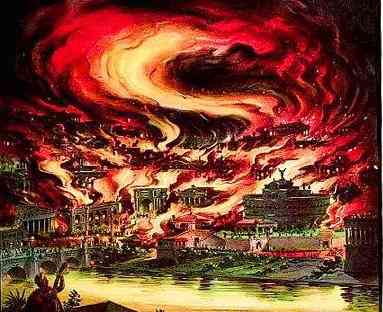
Nero is very famous for his crazy sex life. He had several famous comcubines, most notably Acte. He first married Octavia, who was a "virtuous Roman matron", and decided she was far too boring. He divorced her and married Poppaea, his friend Otho's wife. This was fine, until she annoyed him while pregnant so he kicked her in the stomach and thus induced a miscarriage. This killed her, and he was devastated. Or at least, until he noticed one of his freedmen, Sporus, looked quite a lot like her. He had Sporus castrated, and married him. A bit later on, Nero married himself to Doryphorus (a man) in a large public ceremony. Nero dressed in the bridal veil, and then spent the (public) wedding night "immitating the cries of a virgin". Yup, you read that right.
Apparently even all this got boring, and Nero devised a new game. He had men and women tied, naked, to stakes. He and Doryphorus would then rush out dressed in animal skins and attack their genitals.
Yeah, I don't really get it either.
Go on stage
Do this at any and all opportunity. Nero began by hosting his own pricate "Youth Games" for himself and his friends, but he soon graduated to proper stage performances. His first appearence on a public stage was in Naples where there was an earthquake. He somehow took this as a good omen and refused to stop, declaring the gods were pleased with his performance. From there he went on to "win" all of the acting competitions in Greece (including the Olympics, after he insisted they add a poetry competition).
All of this is reported in the ancient sources, but I feel there is need for some moderation. Josephus says he has no intention of writing about Nero because enough people had left accounts, both good and bad, of his reign. However, the only accounts we have are those of Tacitus and Suetonius. Suetonius wrote under Hadrian (c. 120, so almost sixty years later) and Tacitus under the reign of another "tyrant": Domitian. I can easily believe that much of what they wrote was grossly exaggerated. On the other hand, "Well, it probably wasn't as crazy as all that" wouldn't have made as good a blog.
Subscribe to:
Comments (Atom)