So I don't think I've ever written about gender explicitly on this blog before, but, like, I think about gender a lot. A lot, a lot. I'm also currently taking an undergraduate course in archaeological theory, and this week I've been reading up on it. I've arranged this blog post into stages, which is a way I find helpful for thinking about my thought processes.
N.B.: "Gender" archaeology" and "feminist archaeology" aren't actually synonyms. However, many parts of the discipline do treat them as synonymous, and moreover, everyone kinda just knows that "gender" actually means "women", even when studies of masculinity clearly exist. I'm going to be talking chiefly about gender archaeology, but due to the nature of the work already done, and the way it is perceived, that means I'm chiefly going to be talking about women.
So, you wanna be a gender archaeologist?
1. Acknowledgement of the androcentrism of archaeology (and indeed, academia).
I'm specifically only talking here about androcentric views of the past, but it's important to recognise that female archaeologists working today often face greater barriers to success than men, both in the field and in the library.
The first ever archaeology conference about gender was held in Norway in 1979, and entitled "Were they all men?". It's worth noting that it took until 1987 for the papers to be published, due to academic gatekeeping. The same core question was asked of a BBC documentary series on the Celts, in a review by Rachel Pope in History Today:
"I always wonder when I encounter these utopian masculinist visions of my period, how these men reproduced. I resolved, on watching this programme, that perhaps they do it as worms do. Anyway, I think we should be told."
It's not facile to compare academia with "popular" history in this way; academics are drenched in the same toxic messages of the kyriarchy as the rest of us, as we shouldn't try to pretend otherwise.
Consider, for example, Hodges, 1989, who describes how women were part of gift exchange between Anglo-Saxon England and Frankish Europe. This is deeply androcentric. Even if high-status women did cross the channel to be married, this framing completely ignores the agency of the women in building political alliances and initiating cultural exchange- even though we know that's something high-status women of the age did!
Or how about Johnson, 1993, who studied medieval houses in Suffolk and, with no theortical justification or discussion, designated the central parts of the house as the domain of Man and the peripheral areas as those of Woman?
Feinmann and Price's 2001 "Archaeology at the Millenium. A Sourcebook" barely mentions gender.
In Revell's 2010 critique of Romanization, she remarks that "we generally either depopulate [the questions we ask of the past] or repopulate them with an under theorised adult male (the simulacrum of the majority of researchers)"
A particularly egregious example of how the gender binary and gender roles can distort the record, is Butler's 1987 piece on gravestone imagery in the Medieval period: books, chalices and weapons are identified as "male" images, keys, buckles, purses and shears are "female". When his study encountered a grave with both shears and book, rather than considering, say, the possibility of a subject who was not gendered male or female, or that perhaps his categories were wrong, he simply changed the parameters. There couldn't be such a non-normative person. Perhaps, it was a bale of cloth, not a book, so the person was a male cloth worker. Or maybe it was a sewing box, and the person was a woman. Either way, his study literally could not sustain any grey area, even where it "really existed" (bearing in mind that his categories themselves were constructs). Consequently, he distorted the evidence, to fit it into his gender norms. And he didn't even know he was doing it.
(If anyone's worried about the fact that some of these studies are twenty years old or more, they're probably a scientist! In archaeology, our wheels grind slowly, and it wouldn't be at all unusual to reference things from the 80s in a modern piece of work.)
One really interesting thing about this androcentrism is how it also de-genders men. The man becomes the default, the obvious, and (let's be honest) the mental stand in for a lot of researchers. In this way, he takes on a lot of modern gendered ideas in ways that are a little less obvious and more insidious than the "Man The Hunter" ideal of the 1960s. For instance, there is little discussion of the suggestion that a man was the head of a household, in almost all archaeological contexts I can think of. For someone to suggest a matrilocal society (where men leave their homes/ villages and move to those of their wives/ wives' families) or a matrilineal society (one where property, prestige, rank are passed down through the mother's line, not the father's), extraordinary evidence is called for. Consider, for instance, the controversies over Çatalhöyük. Yet when someone explains movement of, say, a type of spindle whorl through women moving for marriage (invoking patrilocality) (Mytum, 1992) no-one bats an eyelid. There is little room to think about movement or activities of men, unless they are doing the default things imagined by archaeologists, like being in charge of things, and having weapons.
Phew. That section went on a little long, and in my opinion is far more about feminist archaeology than gender archaeology. I suppose the two are more intertwined than I gave them credit for.
2. Pushback from men and "cool women".
So. You've decided to bust this androcentrism thing wide open. You're gonna write about how masculinity and femininity are constructed by archaeologists looking at grave goods. You're going to point out how deeply problematic it is to assume "man" or "woman" as an identity on the basis of a sexed skeleton! (For basic problems with osteological sexing, please see Walker 1995. A PDF may be available here, please let me know if the link is universities-only. If you think gender and biological sex are the same thing, you have a lot of reading to do, but this seems like a good start. Please let me know if you found this article problematic!)
Maybe you'll organise a conference panel, or submit an abstract.
Be prepared for pushback. This comes in many forms. As we saw above, in the 80s especially, the academics in charge of what could be published in the major journals acted as gatekeepers. They did not consider gender archaeology to be a "real" topic worthy of study, and rejected articles because of that. Consequently, many conference publications were significantly delayed, and much ended up circulating as "grey literature"- not quite published work. I'm sure the same thing happens now with other areas of work (queer theory maybe?) but it's harder to do now, since the internet exists.
It can also come in the suggestion that gender in archaeology just isn't that important. You get this from men, obviously, but also from the academic equivalent of the "cool girl". You may not have heard the term, but you've definitely met one. The cool female academic doesn't let her gender, like, define her. She's a woman, sure, but that doesn't mean she has to study women! I mean, come on, we all know that's not real archaeology. She studies wars and subsistence and pots, she doesn't have time for all that feminist bullshit about gender archaeology. And besides, isn't it kinda sexist that all these man-hating feminists want to privilege women over men? Surely that's just as bad! The cool academic probably also reckons they've never seen any of this institutional sexism anyway, and that feminists are probably just being paranoid. I've done a bit of a parody here, but as an undergraduate, another female undergrad definitely told me it was really offensive to assume women might be more interested in studying oppression in the past than their (white) (straight) (able-bodied) male colleagues. This line of thinking contends that only hard-core (and therefore man-hating) feminists want to study gender because it's a fringe subject. It's not "real" archaeology (whatever that is) and so it can safely be ignored.
[Edited to add: Being the "cool girl" academic is often something of a survival strategy employed by women when they realise that their peers who seem to have most of the power are all men. I understand that, but I do find it damaging and unnecessary, and I wish they wouldn't /end edit]
Probably the only good push back is the claim that studying gender is just too hard. Let's look at that now.
3. On the circularity of excavating gender
Just how, exactly, can one see gender in the archaeological record? If Christopher Hawkes had ever thought seriously about gender (and he probably didn't because he was a man in the 1950s) he would have put it right at the top of his ladder of inference. This was a system he used to describe how much guesswork, or inference, archaeologists need to make statements about stuff. So describing a technology like pottery production he ranked as quite easy, but describing religious practice was much harder and required more assumptions.
If you read the Walton paper, you know that there's a lot of grey area in the sexing of skeletons, even just to make a judgement about biological sex. Moreover, once you take into account the fact that someone's primary sexual characteristics (e.g. height, pelvis shape, genitals) may not actually match their gender (as it doesn't for many transgender people, as well as plenty of intersex people) you've got a bit of a problem. What else might you have with the body to help you know what gender it is?
Usually it's grave goods. Unfortunately, the gendering of these goods happens in the eye of the archaeologist! As with Butler, it's usually swords equal men and "domestic" equipment equals women. Even though plenty of people buried with weapons would never have been able to use them- there's plenty of children buried with weapons (and sexing of children is much harder, but usually these are assumed to be boys rather than girls), and some people with disabilities that meant they could never have fought, such as the Amesbury Archer. These assumptions often come from the archaeologists themselves. In some cases, we have literary or visual evidence to recourse to, but in the case of the Archer, they are well pre-literacy, and we have no images of people from that time.
So what can we do? While I don't think we have any good statistics, I do think it is fair to say that in the majority of human cultures, the majority of people have been cisgender rather than transgender. One way to go, then, might be to look broadly at what kinds of objects are generally associated with a particular sex of skeleton (sexed through osteology or DNA where possible), and use these to draw conclusions. However, these models would then need to make allowances for people who do not fit them, and be prepared to accept that they may well be viewing a non-gendered or differently gendered individual. The "male/ female" binary has to go. One option for breaking the binary that has been proposed is the use of stereotype theory. Since my lecturer's paper on it hasn't yet been published, I think I'll leave that there.
However we go about it, we can certainly see that gender archaeology problematises the manner in which a lot of archaeology of gender is done. It may not be impossible to excavate gender, but it's certainly a lot harder than many archaeologists would believe, and that's just one more thing gender archaeology needs to contend with. When so much of archaeology is currently paid for by developers trying to maximise a profit, it can be very hard to convince them of all this "extra" work you want to do.
4. Attrition
The final thing a gender archaeologist, especially an early career one, especially a woman, needs to contend with is attrition. Being told day in and day out, in the academia that we consume that men did things and women stayed home. When almost every reference to women or gender you come across simply reifies the stereotypes that surround you at every turn, in all media, it gets kinda hard to keep fighting it. Maybe you're the one who's distorting the evidence! Maybe in your crazy feminist quest to notice women and gender in the past, you're the one seeing what's simply not there. Maybe men have always done everything. Maybe men are smarter, stronger, keener, better.
I don't believe that's true, but sometimes it can seem like I'm the only one.
Showing posts with label archaeology. Show all posts
Showing posts with label archaeology. Show all posts
Wednesday, 21 October 2015


Wednesday, 4 September 2013
Viking Flat Pack Furniture
Who watched the Vikings? You mean, you haven't seen it? It was basically the greatest thing on TV that I saw this year, and was pretty historically accurate to boot. (Caveat, caveat: as far as I can tell, and I'm by no means an expert on the Vikings).
Anyway.
The Vikings were raiders. And what they used for raiding were longboats. As this 12th century painting shows, there wasn't a whole lot of room in these boats for anything except people.

Detail from "Miscellany on the life of St. Edmund". Obviously, the crowded effect is a little exaggerated.
However, raids generally took more than one day. Longboats have many fine qualities, and their shallow draught allows them to manoeuvre in water as shallow as one metre, which was particularly effective for raiding. Unfortunately, it doesn't leave that much room for things like camping equipment, but here's where Viking ingenuity really came into it's own.
This (a replica, but based on those from Viking graves) is a flat packable table and stool.

Yes, the Scandinavians had flat packing WAY before IKEA. So how does it work? Instead of being nailed together, each piece is drilled with a hole and provided with a corresponding lug. The lug was attached to the piece by twine, so it wouldn't get lost. When you needed it, you put the pieces together, inserted the lugs and it was done and pretty much steady as a rock. When you were finished, you just yanked out the lugs and put it away again.
Genius! I hear you cry. Indeed. But wait, if there's a table AND a stool, how can we tell them apart?
Well, it seems the Vikings thought of that too:

There's an "S" (in the Viking runic alphabet) on the stool pieces

And a "T" on the table pieces.
I feel like an IKEA joke now would cheapen this awesome artefact, so just pretend that I made one. It was the best IKEA joke in the world.
Saturday, 31 August 2013
The Canterbury Oak
Well, I've just taken a scheduled two weeks off for my summer holiday, and now I'm back. I went to Bambrugh Castle on Monday, and as I promised people on Twitter, I learned about a couple of awesome things. This post is about the first:

This is, as you can see, a jug. The (childish) scrawl on the glaze makes the shape of a oak leaf. Or several oak leaves. These crop up all over the country on sites of the Medieval period. Most of them were made for one specific pub: The Oak (or Oak Leaf, or Royal Oak, I'm afraid I can't exactly remember). This pub was famous for pilgrims, and of course, Canterbury was famous for pilgrims.
But then how did they get everywhere? Well, you'd go to Canterbury, and you'd be thirsty when you got there. So, you'd drop into the pub, buy your jug of ale and say to yourself "I'm having that!" Then, when you got home, you'd display it in pride of place so everyone would know you'd been to Canterbury on pilgrimage. And that you were hard enough to have nicked the jar.


This is, as you can see, a jug. The (childish) scrawl on the glaze makes the shape of a oak leaf. Or several oak leaves. These crop up all over the country on sites of the Medieval period. Most of them were made for one specific pub: The Oak (or Oak Leaf, or Royal Oak, I'm afraid I can't exactly remember). This pub was famous for pilgrims, and of course, Canterbury was famous for pilgrims.
But then how did they get everywhere? Well, you'd go to Canterbury, and you'd be thirsty when you got there. So, you'd drop into the pub, buy your jug of ale and say to yourself "I'm having that!" Then, when you got home, you'd display it in pride of place so everyone would know you'd been to Canterbury on pilgrimage. And that you were hard enough to have nicked the jar.
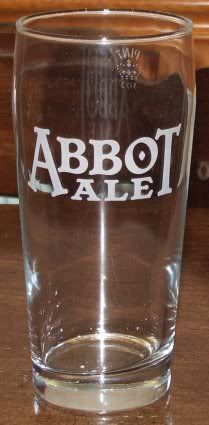
Look familiar?
Monday, 18 February 2013
History isn't a Science
So, I went to a Dawkins thing in Oxford last Friday, and one thing he did really stuck with me. Not in a good way, either, so I thought I'd share it with you guys, and see if anyone on the internet had any similar views.
He was doing a "conversation" event (an informal discussion rather than a debate) with Stephen Law, a philosopher. (You can find his blog here, and it's well worth a read). At one point, Dawkins said [paraphrased] "I'm not really sure what philosophers do. I can't conceive of a problem that cannot be solved with science, but can be solved with just the mind". Law replied with quite a standard philosophical example "If my mother's cousin's son is also my auntie's nephew's brother, can he also be my grandma's niece's son?" Or something. The point is, you solve this question using just reasoning (and maybe a pen and paper), from your armchair. No measurements, observations, or "science" required. That, in a nutshell, is philosophy.
"Aha," said Dawkins, "But that's science!"
And Law said "Well, no, I didn't do an experiment. That's philosophy"
And Dawkins said "Well, no, that's the scientific method: looking at the facts, reasoning things out in a systematic way".
This innocuous little exchange led me to put my finger on something that'd been bothering me for some time. Scientists are right: the scientific method is incredibly important, and based on logic and reason. But it's more than just logic and reason, it's a whole system of hypotheses and null hypotheses and predictions and tests. Those are what make science work, right? A theory has to be testable. Not necessarily in a laboratory: to take a common example, evolution cannot really be "shown" in a lab (well, it can, but whatever), but the theory makes predictions, such as the ages of certain fossils. And these are then found to be right, so we accept the theory (for now, while making more predictions and testing those). If those predictions were wrong, then the theory would be falsified (disproved) and we'd have to build another one.
That is the scientific method.
However, not all logical pursuits require this kind of stringent testing. Dawkins himself in that talk admitted that the interpretation of, say, Romeo and Juliet did not require "the scientific method", but I'm interested in the subjects that fall down the gap between obviously scientific and obviously artistic: specifically history and archaeology.
In history, for example, we base our work on evidence. We look at the available material, usually written down by someone a long time ago, and we ask it questions: "Is that likely?"; "Could the author have really known that?"; "Did someone else say anything different?". We compare sources, and (using a theoretical framework, made explicit in lots of history texts) we assemble a picture of what happened, when and why.
In archaeology, we often go further and use explicitly scientific techniques. Just look at last week's post explaining stable isotope analysis. No one would doubt the techniques and methods employed by archaeologists owe a great deal to science.
However (and this is the really important however), these subjects are not sciences. They are not using the scientific method. They are applying reason and logic in a structured way, but they do not have the same aims as science. Science is answering fundamentally scientific questions: "What is this made of?"; "How does that process work?"; "What are the laws governing this system?"
Archaeology and history are answering fundamentally humanistic (using the traditional philosophical definition, meaning interested in humans and the human experience) questions: "Who was this person?"; "What did this community eat?"; "What was the effect of that belief on this government?"
These two often overlap, but it's important to recognise that they are not the same.
So, when a scientist like Dawkins (or Peter Atkins, or whoever) says that, just by using reason and logic, we are using the scientific method, they claim all such subjects as a science. And that damages these subjects. In the last half century history and archaeology underwent major theoretical changes. These focused a great deal on the scientific method, and whether or not it was what the discipline needed. For archaeology, it prompted processualism (basically the belief that archaeology was a science), and the belief that there really were definite answers that we only lacked the methodology to find. Archaeologists therefore tried long and hard to find and articulate the underlying natural laws that govern archaeology. You know what they ended up with? Things like "If someone has been knapping flint, we can expect to find small shards of flint in the soil, unless the area was cleaned really well". These have been derogatorily called "Mickey Mouse" laws, and it's not hard to see why.
Unsurprisingly, processualism was a bit of a failure (though it did help modernise the discipline, and certainly led to some great research). We didn't find the universal truths we were looking for, and people began to be disillusioned by the whole scientific approach.
This disillusionment happened around the same time (prompted, I assume, by current events: thanks, Cold War!) across the humanities and social sciences. You know what it led to? Postmodernism. Postmodernism which in history and archaeology manifests as a denial of any kind of historical truth. Nothing is true; everything is an opinion. And if everything is subjective, why try to write a true account of anything?
Again, postmodernism forced us to look at our prejudices, and to try to make our theoretical frameworks explicit, and those are all good things, but it's also been reasonably damaging to our fields. Some parts of archaeology and history have lost whole decades to postmodernism (phenomenology, anyone?) , decades we could have been using to do some actual research, instead of worrying about how science didn't work and that there was no such thing as truth.
So back off Dawkins! And back off, scientists. The scientific method is more than just reason and logic, and we can use reason and logic without being a science. Stop claiming otherwise, or you condemn the entire humanities to interpretive nonsense.
He was doing a "conversation" event (an informal discussion rather than a debate) with Stephen Law, a philosopher. (You can find his blog here, and it's well worth a read). At one point, Dawkins said [paraphrased] "I'm not really sure what philosophers do. I can't conceive of a problem that cannot be solved with science, but can be solved with just the mind". Law replied with quite a standard philosophical example "If my mother's cousin's son is also my auntie's nephew's brother, can he also be my grandma's niece's son?" Or something. The point is, you solve this question using just reasoning (and maybe a pen and paper), from your armchair. No measurements, observations, or "science" required. That, in a nutshell, is philosophy.
"Aha," said Dawkins, "But that's science!"
And Law said "Well, no, I didn't do an experiment. That's philosophy"
And Dawkins said "Well, no, that's the scientific method: looking at the facts, reasoning things out in a systematic way".
This innocuous little exchange led me to put my finger on something that'd been bothering me for some time. Scientists are right: the scientific method is incredibly important, and based on logic and reason. But it's more than just logic and reason, it's a whole system of hypotheses and null hypotheses and predictions and tests. Those are what make science work, right? A theory has to be testable. Not necessarily in a laboratory: to take a common example, evolution cannot really be "shown" in a lab (well, it can, but whatever), but the theory makes predictions, such as the ages of certain fossils. And these are then found to be right, so we accept the theory (for now, while making more predictions and testing those). If those predictions were wrong, then the theory would be falsified (disproved) and we'd have to build another one.
That is the scientific method.
However, not all logical pursuits require this kind of stringent testing. Dawkins himself in that talk admitted that the interpretation of, say, Romeo and Juliet did not require "the scientific method", but I'm interested in the subjects that fall down the gap between obviously scientific and obviously artistic: specifically history and archaeology.
In history, for example, we base our work on evidence. We look at the available material, usually written down by someone a long time ago, and we ask it questions: "Is that likely?"; "Could the author have really known that?"; "Did someone else say anything different?". We compare sources, and (using a theoretical framework, made explicit in lots of history texts) we assemble a picture of what happened, when and why.
In archaeology, we often go further and use explicitly scientific techniques. Just look at last week's post explaining stable isotope analysis. No one would doubt the techniques and methods employed by archaeologists owe a great deal to science.
However (and this is the really important however), these subjects are not sciences. They are not using the scientific method. They are applying reason and logic in a structured way, but they do not have the same aims as science. Science is answering fundamentally scientific questions: "What is this made of?"; "How does that process work?"; "What are the laws governing this system?"
Archaeology and history are answering fundamentally humanistic (using the traditional philosophical definition, meaning interested in humans and the human experience) questions: "Who was this person?"; "What did this community eat?"; "What was the effect of that belief on this government?"
These two often overlap, but it's important to recognise that they are not the same.
So, when a scientist like Dawkins (or Peter Atkins, or whoever) says that, just by using reason and logic, we are using the scientific method, they claim all such subjects as a science. And that damages these subjects. In the last half century history and archaeology underwent major theoretical changes. These focused a great deal on the scientific method, and whether or not it was what the discipline needed. For archaeology, it prompted processualism (basically the belief that archaeology was a science), and the belief that there really were definite answers that we only lacked the methodology to find. Archaeologists therefore tried long and hard to find and articulate the underlying natural laws that govern archaeology. You know what they ended up with? Things like "If someone has been knapping flint, we can expect to find small shards of flint in the soil, unless the area was cleaned really well". These have been derogatorily called "Mickey Mouse" laws, and it's not hard to see why.
Unsurprisingly, processualism was a bit of a failure (though it did help modernise the discipline, and certainly led to some great research). We didn't find the universal truths we were looking for, and people began to be disillusioned by the whole scientific approach.
This disillusionment happened around the same time (prompted, I assume, by current events: thanks, Cold War!) across the humanities and social sciences. You know what it led to? Postmodernism. Postmodernism which in history and archaeology manifests as a denial of any kind of historical truth. Nothing is true; everything is an opinion. And if everything is subjective, why try to write a true account of anything?
Again, postmodernism forced us to look at our prejudices, and to try to make our theoretical frameworks explicit, and those are all good things, but it's also been reasonably damaging to our fields. Some parts of archaeology and history have lost whole decades to postmodernism (phenomenology, anyone?) , decades we could have been using to do some actual research, instead of worrying about how science didn't work and that there was no such thing as truth.
So back off Dawkins! And back off, scientists. The scientific method is more than just reason and logic, and we can use reason and logic without being a science. Stop claiming otherwise, or you condemn the entire humanities to interpretive nonsense.
Thursday, 14 February 2013
Richard III
I know, I know I'm late with this post. This news has been out for over a week! But hey, I've been doing my dissertation. We can swap if you'd like.
So, they've found Richard III, last of the Plantagenets. And by "they" I mean "those lovely archaeologists over at the University of Leicester". But how do they know it's him, anyway? Surely one skeleton looks a lot like another? Even if it does have scoliosis.
The folks of UoL put out a brief press statement, which you can read in full here. It says there's a "wealth of evidence, including radiocarbon dating, radiological evidence, DNA and bone analysis and archaeological results". But how can that evidence tell us who someone was?
The first thing we need to know is that Richard III wasn't just on ordinary person. We have lots of historical documents describing him, though some (Shakespeare, I'm looking at you) have always been thought to be inaccurate. Because of our historical knowledge, we can say: "[The skeleton] had unusually slender, almost feminine, build for a man – in keeping with contemperoneous accounts". We also know Richard suffered from scoliosis, which is very easy to spot, and we can look for other details that coincide.

Since Richard was the defeated king, we can expect him to have been killed violently, and the skeletal pathology matches that. While natural causes and most illnesses leave no marks on the skeleton, violent wounds often do, and this skeleton bore fatal injuries to the skull, recorded by pathologists. He also had "humiliation injuries" and may have been tied, both of which also showed up in the pathologists' report.

The state of the body in the grave is another giveaway: this body wasn't in a shroud or a coffin, and had been dumped into a shallow grave.
Before his death, Richard engaged in activities that also allow us to identify him. In the report, they note that he ate a lot of meat, and in particular fish. This would not be surprising if he lived on the coast, but as a body discovered in the midlands, we can assume he was wealthy if he ate fish. But more importantly, how do we know he ate fish?
Keep calm, it's about to get technical. The UoL release says they used "radiocarbon dating" to find this out. I'm convinced this has to be a typo, otherwise I've literally no idea what they mean. We'll assume it's a typo, however, and that they were actually using stable isotope analysis.
So, everyone knows the human body is made of nitrogen (and other elements like carbon), right? If you didn't, you do now. Nitrogen exists in two isotopic forms: N14 and N15. These number just mean the atoms have different weights, though they're both nitrogen. The percentage ratios of these in the body are determined by the percentage ratios of the nitrogen you consume: i.e. your diet. With me so far? Here's the really cool bit: the nitrogen ratios of aquatic plants and animals is markedly different to the ratios of land based plants and animals, so if you have a high sea food diet, your nitrogen ratios are different! Archaeologists then measure these ratios, and can thus partially reconstruct your diet! Stable isotope analysis can be applied to some other elements (strontium and oxygen come to mind) and can tell us about where you lived.
All of this together seems strong, if circumstantial. How many wealthy men with small statures, scoliosis and violent, undignified deaths can there have been? On the other hand, we've so far not proved it's Richard, just some guy who shared many of his unfortunate attributes.
This is where DNA testing comes in, though we won't have been able to sequence a full genome from the bones (since DNA is a very long molecule, it doesn't survive completely intact for very long. I'm afraid that bit in Jurassic Park where they use fossilised DNA is pretty much bunk). However, we should have been able to get quite a bit from his skeleton. Enough to match DNA with a high probability of success, anyway. Genealogists then tracked down two relatives, via maternal line (easier to trace, as everyone has an X chromosome) and matched them to his DNA. This is where it's handy that Richard was a historically documented figure: it's much easier to find relatives if you know which line of gentry you're looking for.
It's pretty safe to say, therefore, that we really have successfully discovered Richard III.
And now, introducing an all new blog feature...
Burns Throughout History #1
This section will preserve tales and anecdotes about people sassing each other, throughout history. This week, we're looking at Athanasius and Arsenius, both Christian bishops at the Council of Tyre. Athanasius had been accused of cutting off Arsenius' hand for heresy, and indeed the grisly trophy had been displayed to the council. Arsenius' followers demanded Athanasius be punished. Athanasius responded:
"He caused Arsenius to be introduced, having his hands covered by his cloak. Then he asked them "Is this the man who has lost a hand?"... [they agreed]... Athanasius, turning back the cloak of Arsenius on one side showed one of the man's hands... afterward he turned back the cloak on the other side and exposed the other hand. Then addressing himself to those present, he said "Arsenius, as you see, is found to have two hands. Let my accusers show the place thence the third was cut off"."
...burn.
So, they've found Richard III, last of the Plantagenets. And by "they" I mean "those lovely archaeologists over at the University of Leicester". But how do they know it's him, anyway? Surely one skeleton looks a lot like another? Even if it does have scoliosis.
The folks of UoL put out a brief press statement, which you can read in full here. It says there's a "wealth of evidence, including radiocarbon dating, radiological evidence, DNA and bone analysis and archaeological results". But how can that evidence tell us who someone was?
The first thing we need to know is that Richard III wasn't just on ordinary person. We have lots of historical documents describing him, though some (Shakespeare, I'm looking at you) have always been thought to be inaccurate. Because of our historical knowledge, we can say: "[The skeleton] had unusually slender, almost feminine, build for a man – in keeping with contemperoneous accounts". We also know Richard suffered from scoliosis, which is very easy to spot, and we can look for other details that coincide.

Scoliosis is a twisting of the spine, easily observable in this image.
Since Richard was the defeated king, we can expect him to have been killed violently, and the skeletal pathology matches that. While natural causes and most illnesses leave no marks on the skeleton, violent wounds often do, and this skeleton bore fatal injuries to the skull, recorded by pathologists. He also had "humiliation injuries" and may have been tied, both of which also showed up in the pathologists' report.

You can just about make out a large crack in the skull, running from the nose to the jaw. In the first image, you can see the other gash in the top of the skull.
The state of the body in the grave is another giveaway: this body wasn't in a shroud or a coffin, and had been dumped into a shallow grave.
Before his death, Richard engaged in activities that also allow us to identify him. In the report, they note that he ate a lot of meat, and in particular fish. This would not be surprising if he lived on the coast, but as a body discovered in the midlands, we can assume he was wealthy if he ate fish. But more importantly, how do we know he ate fish?
Keep calm, it's about to get technical. The UoL release says they used "radiocarbon dating" to find this out. I'm convinced this has to be a typo, otherwise I've literally no idea what they mean. We'll assume it's a typo, however, and that they were actually using stable isotope analysis.
So, everyone knows the human body is made of nitrogen (and other elements like carbon), right? If you didn't, you do now. Nitrogen exists in two isotopic forms: N14 and N15. These number just mean the atoms have different weights, though they're both nitrogen. The percentage ratios of these in the body are determined by the percentage ratios of the nitrogen you consume: i.e. your diet. With me so far? Here's the really cool bit: the nitrogen ratios of aquatic plants and animals is markedly different to the ratios of land based plants and animals, so if you have a high sea food diet, your nitrogen ratios are different! Archaeologists then measure these ratios, and can thus partially reconstruct your diet! Stable isotope analysis can be applied to some other elements (strontium and oxygen come to mind) and can tell us about where you lived.
All of this together seems strong, if circumstantial. How many wealthy men with small statures, scoliosis and violent, undignified deaths can there have been? On the other hand, we've so far not proved it's Richard, just some guy who shared many of his unfortunate attributes.
This is where DNA testing comes in, though we won't have been able to sequence a full genome from the bones (since DNA is a very long molecule, it doesn't survive completely intact for very long. I'm afraid that bit in Jurassic Park where they use fossilised DNA is pretty much bunk). However, we should have been able to get quite a bit from his skeleton. Enough to match DNA with a high probability of success, anyway. Genealogists then tracked down two relatives, via maternal line (easier to trace, as everyone has an X chromosome) and matched them to his DNA. This is where it's handy that Richard was a historically documented figure: it's much easier to find relatives if you know which line of gentry you're looking for.
It's pretty safe to say, therefore, that we really have successfully discovered Richard III.
And now, introducing an all new blog feature...
Burns Throughout History #1
This section will preserve tales and anecdotes about people sassing each other, throughout history. This week, we're looking at Athanasius and Arsenius, both Christian bishops at the Council of Tyre. Athanasius had been accused of cutting off Arsenius' hand for heresy, and indeed the grisly trophy had been displayed to the council. Arsenius' followers demanded Athanasius be punished. Athanasius responded:
"He caused Arsenius to be introduced, having his hands covered by his cloak. Then he asked them "Is this the man who has lost a hand?"... [they agreed]... Athanasius, turning back the cloak of Arsenius on one side showed one of the man's hands... afterward he turned back the cloak on the other side and exposed the other hand. Then addressing himself to those present, he said "Arsenius, as you see, is found to have two hands. Let my accusers show the place thence the third was cut off"."
...burn.
Tuesday, 24 July 2012
Herculaneum: The Harrogate of the Amalfi Coast
Herculaneum is Pompeii's lesser but better preserved sister-city. Sort of like the Joseph Fiennes. Or, Harrogate, in fact. For those of you who don't know it, Harrogate is like a small island of Surry in the otherwise grimdark North Yorkshire. Here's a nice picture of it.

Herculaneum was just down the road from Pompeii, but was destroyed by pyroclastic flows, rather than ash and lava. This means that much of the organic material was carbonised, rather than simply burned, so it survives. Therefore, we have doors, screens and sometimes food preserved! (There will probably be a forthcoming blog about some of the awesome evidence from Herculaneum). Herculaneum was smaller than Pompeii, and its population was wealthier: like Harrogate and its neighbour, Leeds!
Here are two comparisons in greater detail:
Houses
Both Harrogate and Herculaneum were, for most people, lovely places to live. The houses in Herculaneum were often laid out to a recognisable plan: large, grand doors and entrance halls faced onto the street, like this one:

Behind would be a large atrium, decorated in one of four styles. The style depended on the family: were they wealthy enough to keep up to date, and did they want to emphasise their antiquity with a conspicous "old fashioned" style? A bit like deciding if you want to Tudor the front of your house, really. Alongside the atrium would be functional rooms like bedrooms, and behind it, a large and imposing study. Through the study was usually a large and delightful garden. They had slaves to look after them, so the hot weather or indifference of the owners was no excuse. Cicero said "If you have a library and a garden, you have everything you need". And Cicero never did a day's work in his life (Unfair; he actually worked really hard, but I just had to read all of On The Laws and now I hate him. For at least another week.)
The gardens were usually decorated with wall paintings and statues, like these.


Admittedly, this guy (The Faun) is actually from Pompeii.
Harrogate shows similar trends: many houses are large and imposing, with grand gardens. Here are some comparason pictures.

Look Familiar?

Baths
Baths! The Romans were famous for their baths. We named a whole town after one: Bath!
Harrogate is also a famous spa town, still boasting its own Turkish Baths and Spa. In Harrogate, you pay a large amount of money to be treated to the finest in beauty treatments, or something. I've never actually been there. In Herculaneum, the public baths were just that: public. And even better, they were free, though you probably had to tip the slave in the changing rooms to stop people stealing your stuff, and pay someone else to have a slave scrape all your dead skin off. The ancient sources suggest this was a more pleasent experience than that implies. Here are some lovely pictures of Herculaneum's baths.

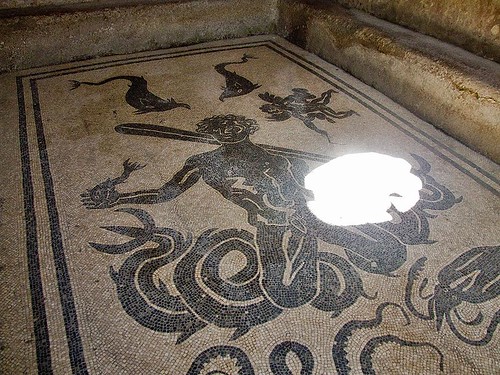
Bathing followed a structure; you didn't just get into the pool and splash about. There were three main rooms: the caldarium, the tepidarium and the frigidarium. As these names might suggest, they were hot, medium and cold. The idea was to enjoy a pleasent sweat in the caldarium, struggle back through to the pleasent tepidarium, and then plunge into the cold water of the frigidarium, usually painted blue to emphasise the feeling of cold.

The lines on the ceiling are grooves to make channels for the condensation

This is from a villa in France, but it clearly shows the stacks and the inlet for the smoke
So there you have it: next time you feel like jetting off somewhere ancient and exotic, think not of the bay of Naples, but of sunny Harrogate. Like all the best places, it's Grim Up North.
Sunday, 11 March 2012
Inconspicuous?
This week I thought I'd continue with the theme of archaeology, and discuss barrows.
What are Barrows?
Simply put, barrows are burial mounds. They are generally not infested with wights, as in Lord of the Rings, or walking skeletons as in Skyrim. They are also much smaller than these things portray them; the Skyrim barrows look far more like catacombs than actual barrows.

Barrows usually, but not always contain burials. These can be of one person, or many people, with wealthy grave goods, or no individual markers at all.
The term 'barrow' applies right the way through from the Neolithic long barrows (above), to Bronze age round barrows (below), to Saxon barrows. That's a period of over 4000 years, so naturally they would have meant many different things in different times. 'Barrow' would not have been the builder's name for them: it's more a classification name, such as 'temple'. Synagogues, churches, mosques and so on could all be called temples, though they all mean something a little different both to believers and non-believers; the same kind of thing applies to barrows, though the different traditions were not concurrent.

As you can see from the two pictured examples, barrow shape and size are very variable. Many barrows were ploughed out by intensive agriculture, but those that remain are now protected, which is why these look like bright green acne in the middle of all that nice farmland.
What are they for?
Barrows were for burying the dead. In the Neolithic, that meant putting a select group of people in the tomb, generation after generation. Once the bodies had rotted a bit, you swept them back towards the sides of the rooms, and put more bodies in. In some long barrows, the bones have been carefully sorted, and in others they're a bit of a jumble. Often recognisable bones such as skulls or long bones were removed, either for reburial elsewhere, or some kind of ritual.
Bronze age barrows are a bit different. They usually had just one burial, and the monument seems to have been raised specifically to hold them. The body was often laid out ceremonially, with many grave goods. We don't really know what these goods were for; whether votive deposits (gifts for the gods), gifts for the dead, items for use in the afterlife or some other purpose. They were often in use for only one generation or so.
Inconspicuous Barrows
But barrows are big, imposing, in-your-face, right? How can a barrow be inconspicuous?
It turns out that there is another class of barrow from the Bronze age. These are usually found near normal barrow clusters, but are tiny. According to one of my lecturers, you pretty much only spot one as you drive over it in your excavation land rover.

Inconspicuous barrows are used for a much longer amount of time. Most large barrows seem to be built, used an abandoned within a few decades. The smaller barrows tend to continue to have deposits placed in them for decades or centuries.
As a tradition, they also continue to be built for longer, and are seemingly less of a thing than large barrows. By the end of the barrow-building period, many large barrow groups have been almost segregated. There are big patches of unbuilt on earth and unfarmed land around them, as if there is something taboo about their presence. Other times, people have enclosed them in small ditches, to 'fence them off' from the normal world. In contrast, inconspicuous barrows are just built around, either non threatening or ignored.
So who were these builders? The Methodists of the Bronze age world? Does this difference in barrows imply a different religious practise, with different beliefs and customs (even a different culture), or are they two traditions from the same belief system, concordant rather than competing?
To link back to the Stonehenge post, we just don't know!
What are Barrows?
Simply put, barrows are burial mounds. They are generally not infested with wights, as in Lord of the Rings, or walking skeletons as in Skyrim. They are also much smaller than these things portray them; the Skyrim barrows look far more like catacombs than actual barrows.

West Kennet Long Barrow, in the Avebury region. There are a couple of people in this picture, but they're so small you can hardly see them. For scale, those stones at the front are all taller than a human.
Barrows usually, but not always contain burials. These can be of one person, or many people, with wealthy grave goods, or no individual markers at all.
The term 'barrow' applies right the way through from the Neolithic long barrows (above), to Bronze age round barrows (below), to Saxon barrows. That's a period of over 4000 years, so naturally they would have meant many different things in different times. 'Barrow' would not have been the builder's name for them: it's more a classification name, such as 'temple'. Synagogues, churches, mosques and so on could all be called temples, though they all mean something a little different both to believers and non-believers; the same kind of thing applies to barrows, though the different traditions were not concurrent.
Bronze age round barrows from near Stonehenge
As you can see from the two pictured examples, barrow shape and size are very variable. Many barrows were ploughed out by intensive agriculture, but those that remain are now protected, which is why these look like bright green acne in the middle of all that nice farmland.
What are they for?
Barrows were for burying the dead. In the Neolithic, that meant putting a select group of people in the tomb, generation after generation. Once the bodies had rotted a bit, you swept them back towards the sides of the rooms, and put more bodies in. In some long barrows, the bones have been carefully sorted, and in others they're a bit of a jumble. Often recognisable bones such as skulls or long bones were removed, either for reburial elsewhere, or some kind of ritual.
Bronze age barrows are a bit different. They usually had just one burial, and the monument seems to have been raised specifically to hold them. The body was often laid out ceremonially, with many grave goods. We don't really know what these goods were for; whether votive deposits (gifts for the gods), gifts for the dead, items for use in the afterlife or some other purpose. They were often in use for only one generation or so.
Inconspicuous Barrows
But barrows are big, imposing, in-your-face, right? How can a barrow be inconspicuous?
It turns out that there is another class of barrow from the Bronze age. These are usually found near normal barrow clusters, but are tiny. According to one of my lecturers, you pretty much only spot one as you drive over it in your excavation land rover.

See that tiny lump these people are standing on? That is an inconspicuous barrow.
Inconspicuous barrows are used for a much longer amount of time. Most large barrows seem to be built, used an abandoned within a few decades. The smaller barrows tend to continue to have deposits placed in them for decades or centuries.
As a tradition, they also continue to be built for longer, and are seemingly less of a thing than large barrows. By the end of the barrow-building period, many large barrow groups have been almost segregated. There are big patches of unbuilt on earth and unfarmed land around them, as if there is something taboo about their presence. Other times, people have enclosed them in small ditches, to 'fence them off' from the normal world. In contrast, inconspicuous barrows are just built around, either non threatening or ignored.
So who were these builders? The Methodists of the Bronze age world? Does this difference in barrows imply a different religious practise, with different beliefs and customs (even a different culture), or are they two traditions from the same belief system, concordant rather than competing?
To link back to the Stonehenge post, we just don't know!
Wednesday, 22 February 2012
Stonehenge
We've all seen Stonehenge, if not in real life, then in pictures. It's a symbol of Britain, and a symbol of Prehistory. I went for the first time ever last week, which is pretty poor, given that I'm an archaeology student within an hour's drive, but I digress.

Stonehenge has been the subject of hundreds of books and papers, thousands of hours of arguments and even some legal cases have been about it. So what's going on here? And why do people care so much?
What's in a name?
Why is Stonehenge called 'Stonehenge'? Like almost everything else about it, Stonehenge's name is a little ambiguous. Almost all of the etymologies suggest it derives from the Old English stan meaning 'stone'. The 'henge' may come from hencg meaning 'hinge', or hencen meaning 'gallows' or 'hanging place'. It is not clear if they were actually using the stones to hang people from, or whether they simply thought that the stones resembled a gallows.
Archaeology took the word 'henge', and used it to define a monument that is circular or ovular, with a ditch and bank structure, and the ditch on the inside, the opposite of a defencive structure. All well and good; we needed a word to describe those pesky circles. Except... Stonehenge doesn't have an internal ditch, and it's bank is pretty pathetic: only about 1m high. So actually, it's not a henge.

It's also, and this is the mind blowing part, not made of stone.
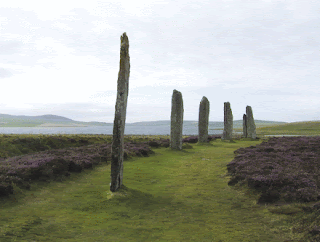
Okay, it is actually stone, but it almost certainly symbolically represents wood, rather than stone. It doesn't look like any other stone circle. Normal stone circles do not have connecting stones on top of the uprights, but this is thought to have been very common in timber circles. Below is a picture of the Stones of Stenness, a 'more typical' stone circle, and a reconstruction of a timber circle.


Who built Stonehenge?
A wizard did it. No, really. Geoffrey of Monmouth in the 12th Century wrote an account of the building of Stonehenge. By Merlin.

Not that Merlin. The proper one. Here's a picture of him directing some giants to help him build Stonehenge.

A bit later on, in the 1600s, a man called William Stukeley had some other ideas about Stonehenge. Stukeley was one of the most important fore-runners to modern archaeology, who drew some brilliant pictures of the monuments, and did quite a bit of 'excavating'. This was closer to Time Team's methods than a real archaeological enquiry, but pioneering for the time. He was also one of the first biographers of Newton, who was a personal friend. Stukeley suggested that it might have been built by the Druids. This isn't as mad as it first sounds: he identified the building as ritualistic in nature, and then looked for a corresponding 'Priestly-caste' in the ancient sources for a people who had lived here before the Romans. The priests he found were the Druids. Druids became quite popular at one time as folk heroes: those Celtic people who had fought the Romans. This was important, because most of the folk heroes of the individual countries of Great Britain were heroes for killing the others. Usually the English.
More recently, thanks to various dating methods, it has become clear that Stonehenge is much, much older than the Druids.* They existed about 2000 years ago, all across Western Europe. By AD86 they had been herded across Europe by the Romans. Agricola, the governor of Britain cornered the last of them on Anglesy and had them all killed.
However, Stonehenge had been built long before that, from about 3100BC - 1600BC, in a series of very distinct phases. Clearly the place was important, but it's meaning would almost certainly have changed over that time. Since we think the average life expectancy was about 30, that's 3 generations a century, or 45 generations in total. That's more than the generations between our time and the time of Jesus.
What does it mean?
No one knows. Is it, as Mike Parker Pearson has suggested, a place that represents death? Would people have processed from Woodhenge (a timber circle), the symbolic place of life to Stonehenge, the symbolic counterpart? Or does it represent life, as a timber circle, immortalised forever as durable stone? Is it a landing place for aliens, an inter dimensional portal, a prehistoric computer?
Jaquetta Hawkes said that 'Every generation gets the Stonehenge it deserves', by which she meant that each new group of archaeologists has a new take on the meaning of the monument, usually at least in part driven by their own ideas about the world.
What Stonehenge meant to the people who built it is likely to be something archaeologists argue about forever, and probably something we will never really know. However, Stonehenge is more than just a dead monument; it has meaning to people in the here and now. In that case, Stonehenge can mean anything you want it to; Stonehenge can be all things to all people, as long as they don't extrapolate that back onto those in the past.
*Note: the Neo-Druids contest this; they continue to believe that Stonehenge was built by Druids.
Stonehenge, showing one of the 'gallows-like' structures
What's in a name?
Why is Stonehenge called 'Stonehenge'? Like almost everything else about it, Stonehenge's name is a little ambiguous. Almost all of the etymologies suggest it derives from the Old English stan meaning 'stone'. The 'henge' may come from hencg meaning 'hinge', or hencen meaning 'gallows' or 'hanging place'. It is not clear if they were actually using the stones to hang people from, or whether they simply thought that the stones resembled a gallows.
Archaeology took the word 'henge', and used it to define a monument that is circular or ovular, with a ditch and bank structure, and the ditch on the inside, the opposite of a defencive structure. All well and good; we needed a word to describe those pesky circles. Except... Stonehenge doesn't have an internal ditch, and it's bank is pretty pathetic: only about 1m high. So actually, it's not a henge.

Avebury, which has an actual henge surrounding the stone circles.
It's also, and this is the mind blowing part, not made of stone.
Okay, it is actually stone, but it almost certainly symbolically represents wood, rather than stone. It doesn't look like any other stone circle. Normal stone circles do not have connecting stones on top of the uprights, but this is thought to have been very common in timber circles. Below is a picture of the Stones of Stenness, a 'more typical' stone circle, and a reconstruction of a timber circle.

Which one looks more like Stonehenge?

The way the lintel (top) stones are attached is also by a method far more suited to woodworking than stone building. Above is a close up of one of the standing stones. See the little bump on the top? That's to attach the lintel stone, which would have a corresponding hole gouged into it. This is still used in Ikea furniture.
Archaeologists have started to think about Stonehenge in the context of timber, rather than stone circles. A good place to start, if you're interested, is Stonehenge and other Timber Circles by Alex Gibson.
Who built Stonehenge?
A wizard did it. No, really. Geoffrey of Monmouth in the 12th Century wrote an account of the building of Stonehenge. By Merlin.

Not that Merlin. The proper one. Here's a picture of him directing some giants to help him build Stonehenge.

This is the oldest known depiction of Stonehenge.
A bit later on, in the 1600s, a man called William Stukeley had some other ideas about Stonehenge. Stukeley was one of the most important fore-runners to modern archaeology, who drew some brilliant pictures of the monuments, and did quite a bit of 'excavating'. This was closer to Time Team's methods than a real archaeological enquiry, but pioneering for the time. He was also one of the first biographers of Newton, who was a personal friend. Stukeley suggested that it might have been built by the Druids. This isn't as mad as it first sounds: he identified the building as ritualistic in nature, and then looked for a corresponding 'Priestly-caste' in the ancient sources for a people who had lived here before the Romans. The priests he found were the Druids. Druids became quite popular at one time as folk heroes: those Celtic people who had fought the Romans. This was important, because most of the folk heroes of the individual countries of Great Britain were heroes for killing the others. Usually the English.
More recently, thanks to various dating methods, it has become clear that Stonehenge is much, much older than the Druids.* They existed about 2000 years ago, all across Western Europe. By AD86 they had been herded across Europe by the Romans. Agricola, the governor of Britain cornered the last of them on Anglesy and had them all killed.
However, Stonehenge had been built long before that, from about 3100BC - 1600BC, in a series of very distinct phases. Clearly the place was important, but it's meaning would almost certainly have changed over that time. Since we think the average life expectancy was about 30, that's 3 generations a century, or 45 generations in total. That's more than the generations between our time and the time of Jesus.
What does it mean?
No one knows. Is it, as Mike Parker Pearson has suggested, a place that represents death? Would people have processed from Woodhenge (a timber circle), the symbolic place of life to Stonehenge, the symbolic counterpart? Or does it represent life, as a timber circle, immortalised forever as durable stone? Is it a landing place for aliens, an inter dimensional portal, a prehistoric computer?
Jaquetta Hawkes said that 'Every generation gets the Stonehenge it deserves', by which she meant that each new group of archaeologists has a new take on the meaning of the monument, usually at least in part driven by their own ideas about the world.
What Stonehenge meant to the people who built it is likely to be something archaeologists argue about forever, and probably something we will never really know. However, Stonehenge is more than just a dead monument; it has meaning to people in the here and now. In that case, Stonehenge can mean anything you want it to; Stonehenge can be all things to all people, as long as they don't extrapolate that back onto those in the past.
*Note: the Neo-Druids contest this; they continue to believe that Stonehenge was built by Druids.
Wednesday, 25 January 2012
What is History For?
I picked this quote up when Hitchins died, and all the news websites felt they should start compiling his sayings or something:
"History is more of a tragedy than it is a morality tale."
And I thought: what does that actually mean? Sure, it's punchy, pithy, and quite Hitchins-esque, but what does it mean?
Well, it's referencing two other famous quotes about history that you might know:
"Those who do not understand the past are condemnded to repeat it" -Santayana
'History happens twice, once as tragedy twice as farce' - Hegel
These are pretty commonly bandied around; chances are you recognise them from a poster in your history classroom at school. All Hitchins seems to mean is that history does not teach us anything about morality, but simply provides us with examples of things going wrong (and the implication is that these are moral wrongs), and then bad, sad stuff happening as a result. Is that really the case? Is that what history is?
What's History Good For, Then?
I'd like to start with the disclaimer that almost every historian today has been asked, or has asked themselves this question, and if there are two answers exactly the same I will be very surprised.
This is also a question I get asked a lot, as an ancient history and archaeology student, and it's one I've read or heard many different answers to. Here are the main headings they fall under.
"Those who do not understand the past are condemnded to repeat it"
As above, this is one of the most common. Thinking back, I can remember asking, and recieving this very answer from a teacher at school. Then, as now, I found it unconvincing. What do they mean? People don't rise from the dead; technology moves on; clearly this is all nonsense. I've grown up a bit since then, but there is still something I don't like about it. It seems to imply that history is in some way circular, and that there is a finite number of outcomes from every concieveable situation: and that they have already happened.
I don't find this convincing, so let's move on.
History tells us where we come from, and if we don't know that, where are we going?
This one rings a few bells for me, and it's one I hold in quite high regard. Of course, I'm not certain that, say, ancient Mesapotamia has had such a hand in shaping our world that not to know about it would render me incapable of going forwards. However, this works well for modern history. I can't rememeber Thatcher, but I certainly know about her, and chances are I'd find a lot of current affairs very confusing if I didn't. But if this is the only reason that we do history, surely we can stick to just recent things, or just things that we can say have directly influenced our culture? This brings us to the next part.
It's our heritage.
History is ours. Implying it is somehow not someone elses? Who is this other person? And how do we decide which history belongs to whom? There is no question that 'local' history is important to people. Just look at the fuss over the Elgin Marbles, or the museum on Orkney that houses all their prehistoric stuff, because they didn't want to send it all the way to Edinburgh. Zimbabwe is even named after an archaeological site. However, does that make Chinese history my heritage? And the Mayans or Aztecs, can I really study them, since they lived so far away?
This is an interesting point, but not one I feel explains very much.
History satisfies some human need for a past.
I'm not sure I disagree with this one. As far as I can tell, all cultures and all societies have a history. It might not be rigorous academic history, or even something we might recognise as true or possible, but they have a past for themselves. A founding myth, or some idea of where they are and how they got there. This tradition continues even today, and not just among 'primitive' peoples. In Northern Ireland, the Unionists and the Republicans both have different reconstructed ideas about Long Kesh/ HM Prison The Maze. Both claim it as their history, but it represents something very different to both groups. (I won't go on about this, but I personally find it fascinating. I'd advise you to check out Laura MacAtackney's work on it if you're interested.)
I think this is why people are interested in history, but I'm not sure if it explains why academic rigour is important (and according to my lecturers, getting the facts right is really important. This argument does not pursuade them to overlook that.)
It's just interesting, it serves no practical purpose
I have heard this one from quite a few people. It takes two forms: either, they're not a historian (and forgive me, they're usually a scientist), and they genuinely just think history is interesting, but not important, like Lord of the Rings. Or, and this one is more for historians, they are kicking back against the idea that history must be for something, like helping people. Physics? Mapping the universe. Chemistry? Investigating the molecular basis of life. Biology? Saving lives. Engineering? Building things. Next to all of that, history can start to look like it's not doing very much, and it's easy to see why historians are so keen to justify it with one, or more, of the above points. Next to that, kicking your heels and going: "It's just interesting!" becomes quite appealing.
You might have noticed that I haven't really answered the question. That's because I don't think I have an answer yet, though I really hope to someday. But enough about what I think: what do you think?
Do you agree with my assessment of the above points, or (more likely) disagree? Have I missed something?
"History is more of a tragedy than it is a morality tale."
And I thought: what does that actually mean? Sure, it's punchy, pithy, and quite Hitchins-esque, but what does it mean?
Well, it's referencing two other famous quotes about history that you might know:
"Those who do not understand the past are condemnded to repeat it" -Santayana
'History happens twice, once as tragedy twice as farce' - Hegel
These are pretty commonly bandied around; chances are you recognise them from a poster in your history classroom at school. All Hitchins seems to mean is that history does not teach us anything about morality, but simply provides us with examples of things going wrong (and the implication is that these are moral wrongs), and then bad, sad stuff happening as a result. Is that really the case? Is that what history is?
What's History Good For, Then?
I'd like to start with the disclaimer that almost every historian today has been asked, or has asked themselves this question, and if there are two answers exactly the same I will be very surprised.
This is also a question I get asked a lot, as an ancient history and archaeology student, and it's one I've read or heard many different answers to. Here are the main headings they fall under.
"Those who do not understand the past are condemnded to repeat it"
As above, this is one of the most common. Thinking back, I can remember asking, and recieving this very answer from a teacher at school. Then, as now, I found it unconvincing. What do they mean? People don't rise from the dead; technology moves on; clearly this is all nonsense. I've grown up a bit since then, but there is still something I don't like about it. It seems to imply that history is in some way circular, and that there is a finite number of outcomes from every concieveable situation: and that they have already happened.
I don't find this convincing, so let's move on.
History tells us where we come from, and if we don't know that, where are we going?
This one rings a few bells for me, and it's one I hold in quite high regard. Of course, I'm not certain that, say, ancient Mesapotamia has had such a hand in shaping our world that not to know about it would render me incapable of going forwards. However, this works well for modern history. I can't rememeber Thatcher, but I certainly know about her, and chances are I'd find a lot of current affairs very confusing if I didn't. But if this is the only reason that we do history, surely we can stick to just recent things, or just things that we can say have directly influenced our culture? This brings us to the next part.
It's our heritage.
History is ours. Implying it is somehow not someone elses? Who is this other person? And how do we decide which history belongs to whom? There is no question that 'local' history is important to people. Just look at the fuss over the Elgin Marbles, or the museum on Orkney that houses all their prehistoric stuff, because they didn't want to send it all the way to Edinburgh. Zimbabwe is even named after an archaeological site. However, does that make Chinese history my heritage? And the Mayans or Aztecs, can I really study them, since they lived so far away?
This is an interesting point, but not one I feel explains very much.
History satisfies some human need for a past.
I'm not sure I disagree with this one. As far as I can tell, all cultures and all societies have a history. It might not be rigorous academic history, or even something we might recognise as true or possible, but they have a past for themselves. A founding myth, or some idea of where they are and how they got there. This tradition continues even today, and not just among 'primitive' peoples. In Northern Ireland, the Unionists and the Republicans both have different reconstructed ideas about Long Kesh/ HM Prison The Maze. Both claim it as their history, but it represents something very different to both groups. (I won't go on about this, but I personally find it fascinating. I'd advise you to check out Laura MacAtackney's work on it if you're interested.)
I think this is why people are interested in history, but I'm not sure if it explains why academic rigour is important (and according to my lecturers, getting the facts right is really important. This argument does not pursuade them to overlook that.)
It's just interesting, it serves no practical purpose
I have heard this one from quite a few people. It takes two forms: either, they're not a historian (and forgive me, they're usually a scientist), and they genuinely just think history is interesting, but not important, like Lord of the Rings. Or, and this one is more for historians, they are kicking back against the idea that history must be for something, like helping people. Physics? Mapping the universe. Chemistry? Investigating the molecular basis of life. Biology? Saving lives. Engineering? Building things. Next to all of that, history can start to look like it's not doing very much, and it's easy to see why historians are so keen to justify it with one, or more, of the above points. Next to that, kicking your heels and going: "It's just interesting!" becomes quite appealing.
You might have noticed that I haven't really answered the question. That's because I don't think I have an answer yet, though I really hope to someday. But enough about what I think: what do you think?
Do you agree with my assessment of the above points, or (more likely) disagree? Have I missed something?
Subscribe to:
Comments (Atom)