Showing posts with label Yorkshire. Show all posts

Tuesday, 24 July 2012

Herculaneum: The Harrogate of the Amalfi Coast


Herculaneum is Pompeii's lesser but better preserved sister-city. Sort of like the Joseph Fiennes. Or, Harrogate, in fact. For those of you who don't know it, Harrogate is like a small island of Surry in the otherwise grimdark North Yorkshire. Here's a nice picture of it.
 

Herculaneum was just down the road from Pompeii, but was destroyed by pyroclastic flows, rather than ash and lava. This means that much of the organic material was carbonised, rather than simply burned, so it survives. Therefore, we have doors, screens and sometimes food preserved! (There will probably be a forthcoming blog about some of the awesome evidence from Herculaneum). Herculaneum was smaller than Pompeii, and its population was wealthier: like Harrogate and its neighbour, Leeds!

Here are two comparisons in greater detail:

Houses

Both Harrogate and Herculaneum were, for most people, lovely places to live. The houses in Herculaneum were often laid out to a recognisable plan: large, grand doors and entrance halls faced onto the street, like this one:

Behind would be a large atrium, decorated in one of four styles. The style depended on the family: were they wealthy enough to keep up to date, and did they want to emphasise their antiquity with a conspicous "old fashioned" style? A bit like deciding if you want to Tudor the front of your house, really.  Alongside the atrium would be functional rooms like bedrooms, and behind it, a large and imposing study.  Through the study was usually a large and delightful garden. They had slaves to look after them, so the hot weather or indifference of the owners was no excuse. Cicero said "If you have a library and a garden, you have everything you need". And Cicero never did a day's work in his life (Unfair; he actually worked really hard, but I just had to read all of On The Laws and now I hate him. For at least another week.)

The gardens were usually decorated with wall paintings and statues, like these.


Admittedly, this guy (The Faun) is actually from Pompeii.

Harrogate shows similar trends: many houses are large and imposing, with grand gardens. Here are some comparason pictures.

http://static.laterooms.com/hotelphotos/laterooms/226584/gallery/dragon-house-harrogate_041020111332298320.jpg
Look Familiar?


Baths

Baths! The Romans were famous for their baths. We named a whole town after one: Bath!
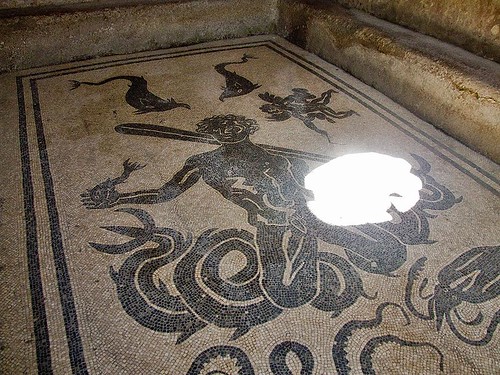
Harrogate is also a famous spa town, still boasting its own Turkish Baths and Spa. In Harrogate, you pay a large amount of money to be treated to the finest in beauty treatments, or something. I've never actually been there. In Herculaneum, the public baths were just that: public. And even better, they were free, though you probably had to tip the slave in the changing rooms to stop people stealing your stuff, and pay someone else to have a slave scrape all your dead skin off. The ancient sources suggest this was a more pleasent experience than that implies. Here are some lovely pictures of Herculaneum's baths.



Bathing followed a structure; you didn't just get into the pool and splash about. There were three main rooms: the caldarium, the tepidarium and the frigidarium. As these names might suggest, they were hot, medium and cold. The idea was to enjoy a pleasent sweat in the caldarium, struggle back through to the pleasent tepidarium, and then plunge into the cold water of the frigidarium, usually painted blue to emphasise the feeling of cold.  
The lines on the ceiling are grooves to make channels for the condensation
 
The caldarium was heated by that most famous Roman invention: underfloor heating, or hypocaust. The floor was suspended on stacks of tiles called pylae. Beneath would be a space for air to circulate, and in the next room a group of unlucky slaves would tend a furnace. The smoke and heat would be drawn under the floor, and then allowed to escape via a chimney.  Harrogate spa, as I understand it, is powered by more conventional means.
This is from a villa in France, but it clearly shows the stacks and the inlet for the smoke


So there you have it: next time you feel like jetting off somewhere ancient and exotic, think not of the bay of Naples, but of sunny Harrogate. Like all the best places, it's Grim Up North.

Thursday, 5 July 2012

Sports That Aren't In The Olympics, But Should Be

The Olympics is just around the corner now, and everyone seems to be overexcited about Team GB's "Chances of Success". By this, I assume they mean our initially promising rounds, followed by disappointing placements of 4th and below in almost all events.

In case that prospect gets you down, here are some awesome sports, ancient and modern, that we don't hold as Olympic games, but perhaps we should do.

The Pankration

First up: pankration, a kind of ancient Greek UFC. It was a cross between  boxing and wrestling, where the only moves not allowed were biting and gouging your opponents eyes. As with all proper sports, pankration was supposedly invented by demi-gods. Theseus used his awesome pankration skills to defeat the Minotaur, and Heracles killed the Nemean Lion in much the same way. It probably arose sometime in the 7th century BC.
Two black figures on red vase background are wrestling. Both are naked, one is overpowering the other.
This is from a handy vase painting.


Pankration was more than just a wrestling competition however. Winners of the pankration were equivalent to modern day sporting heroes, and several of them passed into legend. Pankration was also used asn an essential part of hoplite training by the Spartans and later the Macedonian army.

The pankration continued to be popular after the conquest by Rome, and was a part of the Olympic games for about 1000 years, making it far more traditional than many of the sports we currently hold.


Chariot Racing

Switching to the Hippodrome, the Romans give us chariot racing. Obviously they weren't the only people in the ancient world to use chariots (in fact, they stopped using them for war in the Republic; when invading Britain in the 1st century BC, Caesar was amused that the Britons fielded chariots against him). However the Roman tradition is one of the better understood chariot racing traditions.

To give you some idea of the violence of a chariot race, here's a clip from Ben Hur in dazzling technicolour. The race itself starts around the two minute mark.


And then, I found a Yakety Sax version. Unfortunately, I do not have a transcript for this video.
 
At the Hippodrome in Rome, there were several major teams, all wearing specific colours (not unlike football teams). They would often compete for the services of a particularly skilled driver. Each colour often fielded more than one team per race. These teams would then work together to maximise the chances of a win for their colours. Each colour would also have a staunch following, who often wore the colour to races to show their support. It wasn't uncommon for violence to break out between different groups of supporters. I like to think of Roman chariot racing as a proto-Formula 1.


Gloucester Cheese Rolling

This is not an ancient sport. It might not even be a sport, but it looks horrifying, and totally amazing. All that happens is that a round cheese is thrown down a steep hill, and people chase after it. That's all.


Yes, the still from that video is a man in a mankini. I'm afraid I can't help that. No transcript is required for this video, as all that happens is people chasing cheese downhill.

But just look at their passion! This would also be excellent for our Olympics as all reasonable athletes would take one look at the hill and go "Err.... No, thanks, but I won't be entering this race", and we'd take gold every time.


The Great Yorkshire Pudding Boat Race

 I can't really believe this one exists, but it's on the internet, so it must do, right? Anyway, this one is supposedly the brain child of Simon Thackery, one of the organisers of The Shed in Malton.

Pretty much exactly as mad as it sounds: they make giant Yorkshire puddings, bake them, varnish them with yacht varnish and away you go.

Two children paddle down a river in two giant yorkshire puddings. Yes, really.
I don't know who this child is, but he's having a better childhood than I did. 

So, when Team GB have once again failed to live up to the hype, remember. We might have stood a bit of a chance if they'd included these sports. Maybe.