Showing posts with label ancient history. Show all posts

Wednesday, 12 February 2014

In Your Granary, Eating Your Grains

This may sound like a slightly boring topic, but I promise you it isn't. The question of how to store food from one harvest to the next has plagued humanity since the Neolithic (c. 10,000 BCE- the oldest granary ever found dates to 9000BCE in the Jordan Valley), and we've only had preservative techniques like canning and freezing in the Modern period (i.e. post-Medieval). And, of course, food supply is vital for the survival of human society, so how did ancient societies go about keeping their food safe?


Egyptians

We'll start with a pretty easy one. Egypt grew mostly grain. In general, the floodwaters of the Nile covered most of the farmland with silt every year, providing both water and nutrients to the soil. This allowed for (reasonably) reliable harvests, barring disease or faliure of the floodwaters. Grains were stored in granaries, as the name might suggest. Egyptian granaries looked like this:

A diagram showing the granary: three semi-oval shapes for storing grain above a doorway and two supporting arches. A person is almost the same height as the structure, for scale

Archaeological remains of two arches, which would have supported the granary floor 

A joke picture of Tattooine

If you remember your Bible stories/ Andrew Lloyd Webber musicals: Joseph told them to store up grain for a coming famine. They already did that, but I guess it was good advice anyway. With the climate being so dry, grains stayed edible for several years, and the shape of the granaries- raised but covered- helped create a preservative environment. Keeping them off the ground also made it harder for pests to invade the supply.

The Egyptians also had not-so-secret weapon: Cats. We all know that the Egyptians worshipped cats, and mummified them after they died, but one of the origins of this worship is thought to be their excellent pest-destroying activities. The local wildcats (from whom DNA suggests the Egyptians' cats were domesticated) killed not only rats and mice, but cobras and other poisonous snakes. Of course, this is pretty reductive; if simply killing vermin were enough to cause a culture to worship an animal, there would have been cat-cults all over Napoleonic ships and in every palace kitchen. Unfortunately, the origins of religions are obscure- this is the kind of thing cognitive science of religion is trying to deal with- and many of us in ancient history have stopped trying to search for the origin of religions. We usually don't get anywhere, and when we do we haven't actually learned anything new. Still: CATS.


Ancient Egyptian bronze statue of a reclining cat and kitten
Bronze statue of a cat and her kitten, Ancient Egypt (be more specific, won't you Wikipedia?)


Romans

The Romans did not have such a hospitable climate in much of their empire, especially not from Britain where our next example is from. Recognise this?
Oblong building remains with upright stones sticking up where the "floor" should be

No? Okay then, it's the granary from the Roman fort at Housesteads, on Hadrian's Wall. You'll notice that the floor is covered in square stones. Actually, it's not the floor; those stones would have held up a floor that no longer exists, allowing air to circulate beneath the grain. This helps prevent mould, as anyone living in a student house will know ("Just keep the window's open" "It's winter!" "If you don't keep the windows open, you'll get mould" "?!?!"). It may also have helped keep pests out, though it's unclear whether a foot or so was really enough.

Notice how thick the walls are? This granary (and the one next to it) had to feed the entire garrison from one harvest to the next (presumably- grain transport is tedious, so it makes sense to put it all in once place once it's been taxed off the locals and keep it there). They would pile literally tons of grain up against the walls, so they needed to be pretty sturdy.

Hang on a second!  Walls aren't waterproof! (This is true, actually. It's how damp gets into houses). Romans knew that too, so their granaries had extra wide eaves

A wooden shed in the rain. Water streams off the eaves which are far enough out that the walls are protected. 
This is not a Roman granary, it's a helpful visual aid

This kept water off the walls, and thus, the grain was saved!


Medieval

This one is by far the best and most interesting. As long as by "best" we mean MOST AWESOME. By Medieval times, barns were often massive affairs, intended to hold the tithe grain from large numbers of peasant farmers. They were simply too big to be raised up. If you've ever been into the Buckland Abbey tithe barn, you'll know what I'm talking about.
The inside of Buckland Abbey Tithe barn. High ceiling (maybe four metres), large open space with stone floor and stone walls.

The roof has been replaced, but the walls and floor are, to my knowledge, original.  

However, they had one, awesome and totally amazing innovation: owl chutes. This is a small hole or chute in the wall or roof of the granary which allows owls (most often barn owls) to enter the granary. The owls then find and eat the mice, preventing the mice from eating the grain!

(No, I'm not making this up) 

 
File:Owl Hole - Roughwood.JPG 


Burns Throughout History #8

This one is from a modern archaeologist, who mostly works on the European Iron Age (though he gets around a lot): Barry Cunliffe. You know what he once called Classical Archaeology?

"Text-assisted archaeology"

...burn.

Monday, 18 February 2013

History isn't a Science

So, I went to a Dawkins thing in Oxford last Friday, and one thing he did really stuck with me. Not in a good way, either, so I thought I'd share it with you guys, and see if anyone on the internet had any similar views.

He was doing a "conversation" event (an informal discussion rather than a debate) with Stephen Law, a philosopher. (You can find his blog here, and it's well worth a read). At one point, Dawkins said [paraphrased] "I'm not really sure what philosophers do. I can't conceive of a problem that cannot be solved with science, but can be solved with just the mind". Law replied with quite a standard philosophical example "If my mother's cousin's son is also my auntie's nephew's brother, can he also be my grandma's niece's son?" Or something. The point is, you solve this question using just reasoning (and maybe a pen and paper), from your armchair. No measurements, observations, or "science" required. That, in a nutshell, is philosophy.

"Aha," said Dawkins, "But that's science!"

And Law said "Well, no, I didn't do an experiment. That's philosophy"

And Dawkins said "Well, no, that's the scientific method: looking at the facts, reasoning things out in a systematic way".

This innocuous little exchange led me to put my finger on something that'd been bothering me for some time. Scientists are right: the scientific method is incredibly important, and based on logic and reason. But it's more than just logic and reason, it's a whole system of hypotheses and null hypotheses and predictions and tests. Those are what make science work, right? A theory has to be testable. Not necessarily in a laboratory: to take a common example, evolution cannot really be "shown" in a lab (well, it can, but whatever), but the theory makes predictions, such as the ages of certain fossils. And these are then found to be right, so we accept the theory (for now, while making more predictions and testing those). If those predictions were wrong, then the theory would be falsified (disproved) and we'd have to build another one.

That is the scientific method.

However, not all logical pursuits require this kind of stringent testing. Dawkins himself in that talk admitted that the interpretation of, say, Romeo and Juliet did not require "the scientific method", but I'm interested in the subjects that fall down the gap between obviously scientific and obviously artistic: specifically history and archaeology.

In history, for example, we base our work on evidence. We look at the available material, usually written down by someone a long time ago, and we ask it questions: "Is that likely?"; "Could the author have really known that?"; "Did someone else say anything different?". We compare sources, and (using a theoretical framework, made explicit in lots of history texts) we assemble a picture of what happened, when and why.

In archaeology, we often go further and use explicitly scientific techniques. Just look at last week's post explaining stable isotope analysis. No one would doubt the techniques and methods employed by archaeologists owe a great deal to science.

However (and this is the really important however), these subjects are not sciences. They are not using the scientific method. They are applying reason and logic in a structured way, but they do not have the same aims as science. Science is answering fundamentally scientific questions: "What is this made of?"; "How does that process work?"; "What are the laws governing this system?"

Archaeology and history are answering fundamentally humanistic (using the traditional philosophical definition, meaning interested in humans and the human experience) questions: "Who was this person?"; "What did this community eat?"; "What was the effect of that belief on this government?" 

These two often overlap, but it's important to recognise that they are not the same.

So, when a scientist like Dawkins (or Peter Atkins, or whoever) says that, just by using reason and logic, we are using the scientific method, they claim all such subjects as a science. And that damages these subjects. In the last half century history and archaeology underwent major theoretical changes. These focused a great deal on the scientific method, and whether or not it was what the discipline needed. For archaeology, it prompted processualism (basically the belief that archaeology was a science), and the belief that there really were definite answers that we only lacked the methodology to find. Archaeologists therefore tried long and hard to find and articulate the underlying natural laws that govern archaeology. You know what they ended up with? Things like "If someone has been knapping flint, we can expect to find small shards of flint in the soil, unless the area was cleaned really well". These have been derogatorily called "Mickey Mouse" laws, and it's not hard to see why.

Unsurprisingly, processualism was a bit of a failure (though it did help modernise the discipline, and certainly led to some great research). We didn't find the universal truths we were looking for, and people began to be disillusioned by the whole scientific approach.

This disillusionment happened around the same time (prompted, I assume, by current events: thanks, Cold War!) across the humanities and social sciences. You know what it led to? Postmodernism. Postmodernism which in history and archaeology manifests as a denial of any kind of historical truth. Nothing is true; everything is an opinion. And if everything is subjective, why try to write a true account of anything?

Again, postmodernism forced us to look at our prejudices, and to try to make our theoretical frameworks explicit, and those are all good things, but it's also been reasonably damaging to our fields. Some parts of archaeology and history have lost whole decades to postmodernism (phenomenology, anyone?) , decades we could have been using to do some actual research, instead of worrying about how science didn't work and that there was no such thing as truth.

So back off Dawkins! And back off, scientists. The scientific method is more than just reason and logic, and we can use reason and logic without being a science. Stop claiming otherwise, or you condemn the entire humanities to interpretive nonsense. 

Tuesday, 24 July 2012

Herculaneum: The Harrogate of the Amalfi Coast


Herculaneum is Pompeii's lesser but better preserved sister-city. Sort of like the Joseph Fiennes. Or, Harrogate, in fact. For those of you who don't know it, Harrogate is like a small island of Surry in the otherwise grimdark North Yorkshire. Here's a nice picture of it.
 

Herculaneum was just down the road from Pompeii, but was destroyed by pyroclastic flows, rather than ash and lava. This means that much of the organic material was carbonised, rather than simply burned, so it survives. Therefore, we have doors, screens and sometimes food preserved! (There will probably be a forthcoming blog about some of the awesome evidence from Herculaneum). Herculaneum was smaller than Pompeii, and its population was wealthier: like Harrogate and its neighbour, Leeds!

Here are two comparisons in greater detail:

Houses

Both Harrogate and Herculaneum were, for most people, lovely places to live. The houses in Herculaneum were often laid out to a recognisable plan: large, grand doors and entrance halls faced onto the street, like this one:

Behind would be a large atrium, decorated in one of four styles. The style depended on the family: were they wealthy enough to keep up to date, and did they want to emphasise their antiquity with a conspicous "old fashioned" style? A bit like deciding if you want to Tudor the front of your house, really.  Alongside the atrium would be functional rooms like bedrooms, and behind it, a large and imposing study.  Through the study was usually a large and delightful garden. They had slaves to look after them, so the hot weather or indifference of the owners was no excuse. Cicero said "If you have a library and a garden, you have everything you need". And Cicero never did a day's work in his life (Unfair; he actually worked really hard, but I just had to read all of On The Laws and now I hate him. For at least another week.)

The gardens were usually decorated with wall paintings and statues, like these.


Admittedly, this guy (The Faun) is actually from Pompeii.

Harrogate shows similar trends: many houses are large and imposing, with grand gardens. Here are some comparason pictures.

http://static.laterooms.com/hotelphotos/laterooms/226584/gallery/dragon-house-harrogate_041020111332298320.jpg
Look Familiar?


Baths

Baths! The Romans were famous for their baths. We named a whole town after one: Bath!
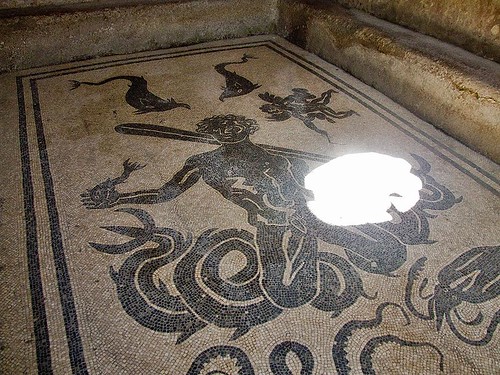
Harrogate is also a famous spa town, still boasting its own Turkish Baths and Spa. In Harrogate, you pay a large amount of money to be treated to the finest in beauty treatments, or something. I've never actually been there. In Herculaneum, the public baths were just that: public. And even better, they were free, though you probably had to tip the slave in the changing rooms to stop people stealing your stuff, and pay someone else to have a slave scrape all your dead skin off. The ancient sources suggest this was a more pleasent experience than that implies. Here are some lovely pictures of Herculaneum's baths.


Bathing followed a structure; you didn't just get into the pool and splash about. There were three main rooms: the caldarium, the tepidarium and the frigidarium. As these names might suggest, they were hot, medium and cold. The idea was to enjoy a pleasent sweat in the caldarium, struggle back through to the pleasent tepidarium, and then plunge into the cold water of the frigidarium, usually painted blue to emphasise the feeling of cold.  
The lines on the ceiling are grooves to make channels for the condensation
 
The caldarium was heated by that most famous Roman invention: underfloor heating, or hypocaust. The floor was suspended on stacks of tiles called pylae. Beneath would be a space for air to circulate, and in the next room a group of unlucky slaves would tend a furnace. The smoke and heat would be drawn under the floor, and then allowed to escape via a chimney.  Harrogate spa, as I understand it, is powered by more conventional means.
This is from a villa in France, but it clearly shows the stacks and the inlet for the smoke


So there you have it: next time you feel like jetting off somewhere ancient and exotic, think not of the bay of Naples, but of sunny Harrogate. Like all the best places, it's Grim Up North.

Saturday, 24 March 2012

Crazy Tales from Herodotus

We all know one. That girl or guy at the party who just can't stop telling you about all those amazing things they saw. They are completely credulous ('No, really, homoeopathy does work; I met an African shaman on my gap year, and they told me about the crystal energies, and how they channel your body's natural healing powers'), and no matter what you've done or seen, they've got an outlandish story to top it.

Guess what folks? Ancient history has one of them too. His name was Herodotus.


Who is this guy?

Herodotus was kicking around in 5th century BC Athens, though he was actually born in Halicarnassus, which is in modern day Turkey. Here is a picture of him.

 There are many, many library statues of Herodotus today.

He was the first person to gather together a 'history' in prose (if we include the Homeric epic poems as 'histories'), in a reasonably systematic manner. This was no mean feat, and probably the work of a lifetime. Herodotus supposedly travelled all over the Greek world, going to Egypt and Sythia and asking for their stories. Unfortunately, these claims are looking more and more tenuous as we learn more about these places from other sources.


What did he write about?

Herodotus claimed to be writing so that 'human events do not fade with time. May the great and wonderful deeds- some brought forth by Greeks, others by the barbarians- not go unsung; as well as the causes that led them to make war on each other' - proem, Histories. In practise, this was chiefly the Graeco-Persian Wars (you may remember them from such films as The 300 Spartans and 300).

However, 'Histories' in Greek means 'Enquiries', and as well as a history, Herodotus' work is also also ethnography, geography, zoology and general interest. Herodotus was actually very scrupulous by the standards of his day; but unfortuntely, our standards of what comprises history and myth have altered somewhat, and now poor Herodotus' work looks quite ridiculous indeed.


Here are some of his best* stories:

Kandaules and his wife (1.8-12)

Kandaules, king of Lydia, we are told, was a very lucky man indeed: he was in love with his wife, and he thought her the most beautiful woman in the world. All well and good. Unfortunately, he was pretty certain his bodyguard Gyges didn't really believe him about this. Naturally the solution was for Kandaules to arrange for Gyrges to spy on his wife while she was undressing, so that he would truly appreciate the wonder of her naked form. Yes, you did read that right.

Gyges initially refused, saying "I beg you not to ask for what is against all decency." But Kandaules was king, and he could have whatever he wanted, so the plan was arranged. Gyges got to play the peeping tom and agreed, she was really, really attractive. But the story doesn't end here. The queen found out about all this, and decided to take her revenge.


 Candaules, King of Lydia, Shews his Wife by Stealth to Gyges, One of his Ministers, As She Goes to Bed by William Etty.


So, in turn, she went to Gyges, and offered him a choice. He had seen her naked, which was a great dishonour. Either he must die, or must kill her husband (the king), marry her and become king himself. I think we all know what we would have done in that situation. Kandaules died, Gyges became king and about four generations later, the gods saw fit to punish his offspring. Seems legit.


Hippopotamus

Herodotus describes the hippopotamus, which he saw on his travels in Egypt. 'This animal has four legs, cloven hoofs like an ox, a snub nose, a horse's mane and tail, conspicuous tusks, a voice like a horse's neigh, and is about the size of a very large ox. Its hide is so thick and though that when dried it can be made into spear-shafts' - 2.73 Histories

Uh... yeah. Looks totally like a hippo.


There are several  schools of thought that say that Herodotus never actually went to Egypt. This is definitely in their favour. It is commonly thought that Herodotus took this description from Heceateus of Miletus, and probably neither of them ever saw a hippo, which were extinct in the Nile region by this time anyway. The only other description from Antiquity is the one from Job 40.10, which is equally bad.


Alexander, the Persians and a certain amount of cross-dressing (5.18- 5.21)

No, I didn't just fail on my history. Alexander the Great (who did go to Persia,  kill an awful lot of Persians, and began wearing something as effeminate as trousers) was Alexander III of Macedon. This was one of this predecessors, and only a prince when all this happened. Alexander the Great comes quite a bit later.

In the Graeco-Persian war, the Macedonians capitulated to Persia. Tactically, this was probably the best thing they could have done; had they fought back they would have been on their own (no Sparta or Athenian help; they weren't considered 'Greek' enough), and without any major defences or allies. As was the norm, King Darius of Persia asked for an offering of earth and water. The ageing king, Amyntas, agreed, and threw a large banquet to celebrate.

Only men were present at this banquet, as was the Macedonian custom, but the Persians demanded that women be brought out for them to admire. They claimed to be dazzled by the beauty of the women, and got pretty handsy.

Amyntas was pretty distressed about all this, and his son Alexander was livid. Alexander sent his father to bed (plausible deniability) and then set about getting even. He told the Persians he was sending the women out to bathe before sending them to bed with them (presumably without the women's consent). The Persians were incredibly drunk by this point. Alexander sent the women off and found some young men without beards, dressed them in women's clothing, and equipped each one with a dagger. He then sent them back in.

When the Persians tried to touch the new "women", they were set upon and all of them stabbed to death. Somehow, mostly by bribes, the inquest into this found no guilt on the part of the Macedonians.

This story is all very dubious indeed; it is far more likely to be a retrospective invention to justify their banquet with the Persians after the Greeks had been the victors.


*Note, there are many, many bizarre and amusing stories from Herodotus. If someone told you one that's not in this list, it's probably in there anyway. The only exception is the flying snakes, (bet Samuel L. Jackson would have loved those) which are commonly attributed to Herodotus but which are actually from Lucan.

Wednesday, 29 February 2012

Quis Custodiet Ipsos Custodes?

Who watches the watchmen?

It's one of the serious quotes from the ancient world; one that rings with stifled civil liberties and police state. Jeremy Paxman has probably said it when discussing ID cards. Alan Moore's Watchmen is named after it.

A cursory google will bring up dozens of images like the one below:


However... it's from one of Juvenal's Satires. No. 6 lines 346-348. That should start setting off alarm bells, if you know your ancient authors. Or what 'Satire' means. Here's a picture of him.

 He probably didn't look anything like this. But if he did, he would have made a great Scrooge.

Juvenal, for everyone else, was a comic poet who liked to complain about things. There was something of the Frankie Boyle about him, though being able to turn that rage into poetry is probably beyond Boyle. You know what's worse that living in Rome? Nothing. Except not living in Rome. That was Juvenal's kinda thing.

So what was Juvenal actually complaining about? The police state in the 1st Century? The reign of terror perpetuated by the Emperor's secret team of Avengers? If only.

Unfortunately no. He was complaining about his wife, who was younger than him, and probably going to have sex with all this friends, which would be really embarrassing. The 'full' quote reads:

'I hear always the admonishment of my friends:
"Bolt her in, constrain her!" But who will watch
those watchmen? The wife plans ahead and begins with them!'

So next time you hear someone say it with a po face and a serious demeanour, just remember: they might think that they sound profound of well educated by quoting a classical author at the problem, but they're really just bemoaning the problems of marital infidelity.

Tuesday, 14 February 2012

UBU AGM: Athenian Democracy in Practice?

I'm sure most of you in Bristol attended, or heard about the AGM at Bristol Uni last week, but a quick recap for everyone else:

On Thursday of last week, (9/2/12), the University of Bristol Students' Union held their Annual General Meeting (AGM). This is a chance for students to propose motions about the things that affect and concern them; the chance to speak against motions that they think are a bad idea, and ultimately to vote on the things they'd like the Union to do in the next year. It is, notably, not when we elect officials; their campaigns are coming later.


A 19th century painting of the Athenian Assembly. 
Sadly, no-one at the AGM had so awesome a hat, but I may propose the Chair wear such a hat as a motion next year.


How could a bunch of students hope to imitate the practises of democratic Athens?


Attendance

The student AGM, like Athens, practises direct democracy. This means that every citizen, or member of the Students' Union is entitled to attend, and vote or abstain as they please. Most modern democracies, including Britain and the USA practise indirect democracy: we elect people to speak on our behalf at our assembly (or Parliament). However, there is nowhere near enough room in the Union Building, or the university, for all of the student body to be accommodated, if they chose to attend. Even 50% of the student body would present serious difficulties:  there are almost 20,000 of us. Therefore, attendance is merely those people who are interested, and not busy with something else, and usually with a vested interest. Are these people representative of the student body? How would we find out?

Athens may have been faced with similar problems. We do not have any exact population data for Athens (I'm afraid there are no ancient statistics. Anyone who tells you otherwise is wrong or lying), but there were almost certainly more Athenian citizens than students, and probably not enough space for them. Many citizens also owned land, and farmed it for a living; Athens was an agrarian economy, and very dependent on grain coming into the city. If you lived more than a day's walk from the city, you would probably only attend at important elections, or if you were in the city anyway, either fleeing the Spartans or coming to celebrate a festival.  As many modern day farmers will tell you, it's hard work, and leaves little time for politics.

However, the Greeks in general and the Athenians in particular were very, very keen on politics. While ignoring the AGM might (at worst) get you branded as 'apathetic', an Athenian would call you itiotes: a person not interested in politics. It is from this word that we get out modern 'idiot'. There is also a fun myth that slaves would walk through the streets with a cloth barrier dipped in red paint, herding the citizens to the assembly. Anyone with red on his toga ('...you've got a bit of red on you') would be shamed for the rest of the day.


Food

Obviously, you can't expect a bunch of students (or politicians) to attend a meeting without providing adequate refreshments. Athenians almost certainly brought food and drink to sustain them while they spent the day listening to grown men insulting each other, I mean, making serious speeches about things. And by 'drink' we should read 'wine': water was usually unsafe, and no-one thought of fruit juice unless you let it ferment
first.

 Incredibly ornate Greek wine mug. You probably wouldn't take something this nice to the Assembly.


At the AGM we were enticed in with pizza and drinks, and a local company thought to advertise themselves on top of cupcakes. I have no memory of the name on them,  but they were good cupcakes.

It seems plausible that voters were 'bribed' with food and drink; they certainly were in Roman elections a few centuries later. Many of the attendees would have been poor, with their citizenship status the only real difference between themselves and migrant workers, or worse: slaves. It is hard to imagine that Athenian politicians would fail to capitalise on this opportunity.


Speeches

All politics, it seems, rests on the powers of speech making. At the AGM, speakers were limited to two minutes. In Athens, it was a good deal longer than that, but still timed by water clock. It was considered the mark of a good statesman to speak exactly to time. Anyone who has read Thucydides or Herodotus knows just how many speeches there seemed to be, and how long they went on for. Often, you can imagine these speeches being spoken pretty much as they are by modern politicians. Demothenes' On the Crown and Pericles' Funeral Oration in Thucydides are good examples. Don't believe me? Go read them for yourself, and imagine David Cameron or Ed Milliband speaking.


'And furthermore, I refer my honoured colleague to the recent publication in The Times...'

The popularity or reputation of the speaker could often influence the vote, regardless of what was actually said. The same kind of behaviour appeared at the AGM: 'So and so is speaking against... I think I'll vote for.'


Voting

Voting at the AGM was done by remote control, and in a couple of minutes we had the results on the screen. In Athens, there were far too many people at full Assembly to vote by lot, so they did it by show of hands. Obviously, this meant that you could win a close vote by bribing the counting officials, who had to do it by eye. There were some things considered important enough to put to a secret ballot, however. The most famous was the Ostracism vote: all the citizens were asked to choose who they thought was best able to establish a tyranny (one man rule) over Athens. They would write his name down on a pot sherd (below) and then these would be counted. The person with the post votes was then exiled for ten years, to make sure that he couldn't establish this tyranny, but his property was not siezed by the state. When his term was up, he could return and reclaim his place in politics. 

Ostracon bearing the name 'Cimon' an Athenian statesman and possible Spartan sympathiser.

'Just because you don't take an interest in politics doesn't mean politics won't take an interest in you'- attributed to Pericles, Athenian leader, and (according to Thucydides) the greatest statesman that ever lived.

Wednesday, 25 January 2012

What is History For?

I picked this quote up when Hitchins died, and all the news websites felt they should start compiling his sayings or something:

"History is more of a tragedy than it is a morality tale."

And I thought: what does that actually mean? Sure, it's punchy, pithy, and quite Hitchins-esque, but what does it mean?

Well, it's referencing two other famous quotes about history that you might know:  

"Those who do not understand the past are condemnded to repeat it" -Santayana

'History happens twice, once as tragedy twice as farce' - Hegel

These are pretty commonly bandied around; chances are you recognise them from a poster in your history classroom at school. All Hitchins seems to mean is that history does not teach us anything about morality, but simply provides us with examples of things going wrong (and the implication is that these are moral wrongs), and then bad, sad stuff happening as a result. Is that really the case? Is that what history is?


What's History Good For, Then?

I'd like to start with the disclaimer that almost every historian today has been asked, or has asked themselves this question, and if there are two answers exactly the same I will be very surprised.

This is also a question I get asked a lot, as an ancient history and archaeology student, and it's one I've read or heard many different answers to. Here are the main headings they fall under.


"Those who do not understand the past are condemnded to repeat it"
As above, this is one of the most common. Thinking back, I can remember asking, and recieving this very answer from a teacher at school. Then, as now, I found it unconvincing. What do they mean? People don't rise from the dead; technology moves on; clearly this is all nonsense. I've grown up a bit since then, but there is still something I don't like about it. It seems to imply that history is in some way circular, and that there is a finite number of outcomes from every concieveable situation: and that they have already happened.

I don't find this convincing, so let's move on.


History tells us where we come from, and if we don't know that, where are we going?
This one rings a few bells for me, and it's one I hold in quite high regard. Of course, I'm not certain that, say, ancient Mesapotamia has had such a hand in shaping our world that not to know about it would render me incapable of going forwards. However, this works well for modern history. I can't rememeber Thatcher, but I certainly know about her, and chances are I'd find a lot of current affairs very confusing if I didn't. But if this is the only reason that we do history, surely we can stick to just recent things, or just things that we can say have directly influenced our culture? This brings us to the next part.

It's our heritage.
History is ours. Implying it is somehow not someone elses? Who is this other person? And how do we decide which history belongs to whom? There is no question that 'local' history is important to people. Just look at the fuss over the Elgin Marbles, or the museum on Orkney that houses all their prehistoric stuff, because they didn't want to send it all the way to Edinburgh. Zimbabwe is even named after an archaeological site. However, does that make Chinese history my heritage? And the Mayans or Aztecs, can I really study them, since they lived so far away?

This is an interesting point, but not one I feel explains very much.


History satisfies some human need for a past.
I'm not sure I disagree with this one. As far as I can tell, all cultures and all societies have a history. It might not be rigorous academic history, or even something we might recognise as true or possible, but they have a past for themselves. A founding myth, or some idea of where they are and how they got there. This tradition continues even today, and not just among 'primitive' peoples. In Northern Ireland, the Unionists and the Republicans both have different reconstructed ideas about Long Kesh/ HM Prison The Maze. Both claim it as their history, but it represents something very different to both groups. (I won't go on about this, but I personally find it fascinating. I'd advise you to check out Laura MacAtackney's work on it if you're interested.)

I think this is why people are interested in history, but I'm not sure if it explains why academic rigour is important (and according to my lecturers, getting the facts right is really important. This argument does not pursuade them to overlook that.)


It's just interesting, it serves no practical purpose
I have heard this one from quite a few people. It takes two forms: either, they're not a historian (and forgive me, they're usually a scientist), and they genuinely just think history is interesting, but not important, like Lord of the Rings. Or, and this one is more for historians, they are kicking back against the idea that history must be for something, like helping people. Physics? Mapping the universe. Chemistry? Investigating the molecular basis of life. Biology? Saving lives. Engineering? Building things. Next to all of that, history can start to look like it's not doing very much, and it's easy to see why historians are so keen to justify it with one, or more, of the above points. Next to that, kicking your heels and going: "It's just interesting!" becomes quite appealing.


You might have noticed that I haven't really answered the question. That's because I don't think I have an answer yet, though I really hope to someday. But enough about what I think: what do you think?

Do you agree with my assessment of the above points, or (more likely) disagree? Have I missed something?

Sunday, 15 January 2012

Five Things About Sparta You Can't Learn From 300

1. Two Kings. At the same time.

In 300, there's just Leonidas, but most of the time the Spartans actually had two kings in office. There were two separate royal lineages, the Agids, who were marginally more important, and the Eurypontids, and are supposedly derived from the legendary twins Eurysthenes and Procles.

This actually caused fewer problems than you might think, because the Spartan kings were not autonomous. There were several other groups who had control of things like law and government policy. The kings were more like permanent generals. Once, two kings (Cleomenes I and Dematatus) went on campaign together, had a girly spat about Athenian democracy, culminating in Dematatus going home early and taking the ball- or in this case, their helpful allies the Corinthians. Naturally, they couldn't be friends after this, and Cleomenes eventually schemed to have Demaratus overthrown. Demaratus then fled to Persia, where he advised Xerxes about the Spartans at Thermopylae. This incident culminated in legislation preventing them both from going on campaign at once.

Other powers of the kings were mostly army-based. They were head of their barracks, and allowed two of the allotted rations of food, though the implication was that this was to award to someone else, rather than something they got to keep for themselves. It's also not as cushy as it sounds: one visitor, after tasting their famous 'blood soup' remarked that he "now knew why the Spartans were so keen to die". They were also, crucially, allowed a personal body guard of up to 300 men. Which brings us to...


2. Extremely Pious

As Herodotus puts it, the commands of the gods were more important to the Spartans than the commands of mortals. While in 300 the Ephors are crazy, inbred, historically inaccurate monsters, that they forbid the war is actually correct. The Spartans in general were incredibly pious, always making certain to run their decisions by the Oracle at Delphi, and making sure to check the animal guts before they did anything.

One guy, Tisamenos, an Elean, went to the Oracle to ask 'how to get children'. I'm not sure exactly what he meant by that, but I like to think they were having fertility trouble, rather than that he just didn't know what to do. Instead of offering any helpful advice, she told him he would win five great contests. He assumed that he would win the pentathlon, and promptly entered. He only won four of the five events, so clearly this couldn't have been what the Oracle was talking about, which meant he was clearly going to win five battles. The Spartan nobility decided to try and engage him as their divine auger, to check the omens were right before they went into battle. They were so desperate to have him onside that he was able to secure full Spartan citizenship for himself and his brother, the only two foreigners known to have achieved this.

At the time when Leonidas wanted to leave Sparta for Thermopylae, it was the Carneia, one of the most important festivals of the calendar, and so (supposedly) the army wasn't allowed to march to war. Hence, Leonidas and his 300 bodyguards decided to "take a walk".

Just this once, that excuse might have worked, except that this was their excuse for not being at Marathon too. It's generally thought a lot more likely these days that they didn't like to leave the city for too long in case of a slave revolt.


3. Slave Population

They didn't show up at all in 300, but all Spartan warriors had an allotted number of Helots, who were a kind of mixture of serf and slave. Serfs in that they were allowed to keep some of their produce, and slaves in that they were owned and could be disposed of by their masters. Though almost all Greek cities kept actual slave populations, they had only enslaved foreigners, who were obviously naturally inferior, whereas Sparta enslaved fellow Greeks which was clearly not on. These slaves were the people of nearby villages and a neighbouring town, of Messenia.

Myron of Priene said that: "They assign to the Helots every shameful task leading to disgrace. For they ordained that each one of them must wear a dogskin cap and wrap himself in skins and receive a stipulated number of beatings every year regardless of any wrongdoing, so that they would never forget they were slaves. Moreover, if any exceeded the vigour proper to a slave's condition, they made death the penalty; and they allotted a punishment to those controlling them if they failed." and Plutarch adds that they were forced to drink neat wine until drunk, and then "lead them in that condition into their public halls, that the children might see what a sight a drunken man is; they made them to dance low dances, and sing ridiculous songs."

The numbers of these slaves and the number of  Spartan warriors varied over time, but at the most extreme there were probably 10,000 Spartans and 250,000 Helots. Obviously, being this outnumbered, they had to take some quite bizarre measures in order to control them.

Myrion of Priene again: "The helots were invited by a proclamation to pick out those of their number who claimed to have most distinguished themselves against the enemy, in order that they might receive their freedom; the object being to test them, as it was thought that the first to claim their freedom would be the most high spirited and the most apt to rebel. As many as two thousand were selected accordingly, who crowned themselves and went round the temples, rejoicing in their new freedom. The Spartans, however, soon afterwards did away with them, and no one ever knew how each of them perished."

As you can imagine, the Spartans weren't too keen to take their army away from the city, when there could be a revolt in their absence. There were several very serious ones during Sparta's hey-day, including one that lasted ten years.

It is another attempt to control the Helots that forms out next section.


4. Roving Death Squads of Teenagers

You've probably heard all about the Spartan school system. If not, here's a handy explanatory video. Reports vary, but either in your last year in the system, known as the Agoge, or just afterwards, and in both cases were really good at being a Spartan, you were drafted into the Krypteia. This was essentially the Spartan secret police, who existed mostly to prevent Helot revot by killing them whenever and wherever they saw fit. They were presumably selected by the Boy Herd, who oversaw the whole Agoge. Being selected was a great honour, and usually earmarked you for one of the higher offices of state. Like many other Spartan practices, the Krypteia was all about becoming a better soldier, and, unexpectedly, this last point was designed to do just that.


5. Dance Champions of the Greek World

The Spartans were all about being the best at things. If that included singing and dancing in unison, well, fine then. According to Cartledge, ''The Spartans were famed for dancing in general, and  for one particular military dance, the Pyrrhic''.

The reason the Spartans were so good at fighting was (as we learned from 300) that they were really, really disciplined at phalanx fighting. Co-ordination in phalanx formation is incredibly important, so all the dancing and singing in groups had two purposes: one, to help everyone keep in step when it really mattered (i.e. when fighting the Persians or the Athenians), and two, to keep the gods onside, because dancing and singing were also forms of cultic worship, and as we saw earlier, the Spartans were pretty damn pious.

You heard it here first guys. Unless you've read your Cartledge.

Sunday, 8 January 2012

Top Four (Recent) Films Set In The Ancient World

This week, I'm pretty busy with revision and other things for the start of term. However, I am pleased to present you with some films set in the ancient world that you might enjoy.

Troy

Plot, as I'm sure you're all aware, is that the Greeks vs Trojans in a fight to the death over Orlando Bloom stealing someone's wife.

It is nicely put together, I'll give it that. The armour and so on, I am reliably informed, is not particularly accurate, but then, it is based c. 1100 BCE, and our information about quite what they were wearing at that time is a bit patchy. No contemporary issues of Vogue remain. But it all looks pretty; the beaches look sandy and Troy looks suitably like a city surrounded by implausible walls. Some solid performances, though no one was required to do anything more difficult than scowl or pout, of which the favourite has to be Brian Cox as Agamemnon. He seems to get everywhere these days.

Historical accuracy? Well, Troy is based on Homer's epic poem, The Illiad, rather than on a sound historical account, and the accuracy of the events that it depicts has been debated for (literally) millennia. So... as mentioned above, costuming is probably not accurate to time period. The plot, however, doesn't really manage to stick with the plot of The Illiad. For a start, where have all the Gods gone? What about the duration of the war? Where are Priam's other sons? I'm sure any classics geeks out there would be glad to add to this list for me.

6/10

The Eagle

Fewer people have heard of this one, perhaps for good reason. Plot: The Ninth Legion mysteriously disappeared north of Hadrian's Wall, losing their Eagle standard. Now, a (slightly) crippled army officer and his British slave must get it back.

This is really quite enjoyable, as one-man-and-his-dog (or in this case, slave) films often are. The dialogue is stilted at times, particularly in the "serious" scenes, where the Roman is forced to confront Rome's brutality (Sample dialogue: "Rome is wonderful" "Rome killed my father, my mother, and all of my brothers. It was going to put me to death in an arena" "....Oh"), and the depiction of the tribes north of the wall is laughably bad. Why aren't they wearing any clothes? This is Scotland; it gets cold in Scotland. They almost seem to have wandered off the latest Cowboys-and-Indians set, where they'd still be inaccurate, but less out of place.

Any other historical inaccuracies? The whole plot, for a start, is ridiculous. The IX legio Hispania is last attested in Dacia (Eastern Europe) rather than Britain, and was probably disbanded due to ill-luck, than completely destroyed. However, since that is the plot of the book (Rosemary Sutcliffe's The Eagle of the Ninth) on which this film is based, I'm prepared to overlook it. My favourite inaccuracy is that of the crossbow brooches (see figure below). In the film, these are worn on the chest like modern brooches, with short bar pointing up, like a crucifix. The Romans themselves would have worn them the other way up (like the inverted or 'satanic' crucifix), and protruding from the top of the shoulder, like a clothes peg. It's my favourite because it means whoever designed the costumes really bothered to do their research, and then someone later mis-heard them, and now they have upside down Roman brooches in their film.


7/10
 
300

This is practically a genre classic by now, isn't it? Even if that genre is just slow-mo and cartoony blood. You can tell because Spartacus: Blood and Sand tried, and failed to replicate it.

Plot: This is SPARTA! and they send out 300 troops to hold back a Persian army of c.1,000,000. Yeah, okay guys.

Like the others, it's well put together, but unlike the others, the poor dialogue doesn't grate because it somehow fits with the ridiculous machismo of the rest of the film. It's slick, silly and with a whole lot of violence. What's not to love?

Historical inaccuracies? It'd be easier to list things that were accurate. Firstly: why aren't they wearing any clothes? Well, traditionally the Spartans went to war naked, but they'd started wearing armour by the time they fought with the Persians, so... artistic license? Really, just 300 guys? Yup. 300 Spartans, that is. About 20,000 people from other cities, but the Spartans were having a festival, and it's quite hard to spare more dancers when you need to put on a show. Fun fact: the Spartans were actually the dance champions of the Greek world. Those ridiculous one liners? From Herodotus and Diodorus we get "Tonight we dine in hell", "Then we shall fight in the shade" and "You'll find plenty of earth and water down there [the well]". Sadly, they left out the bit where the Athenians threw their own Persian envoys into The Pit.

 Score 10/10

Life of Brian

Classic, guys, classic. Plot: Monty Python comedy film about Judean Messianic figures around the time of Jesus. How could it fail?

I, and most of my friends, have seen this film so many times we could probably re-enact it ourselves with just fake beards and a gourd. And it's still funny. And, as I learn more about the history of Judea, it actually gets funnier. There's no need to go on about how great this film is: if you've seen it, you know what I'm talking about, and if you haven't do so. Immediately.

Inaccuracies? Actually, it does quite well. There were dozens, if not hundreds, of ineffective splinter resistance groups, all believing slightly different things about god. There were also dozens of chanting prophets, and dozens of people hailed as the Messiah. Jesus was either the real one, or incredibly persuasive, depending on your point of view. As a Roman citizen, you had the right to be tried by the governor, or the Emperor (a right enjoyed by both Brian and St Peter), and as I'm sure we're all aware, crucifixtion was relatively common for executions.

10/10


Hang on: what happened to Gladiator?

Sorry, but I just don't like Gladiator. I know it won all those Oscars, but I really don't think it's that good. The opening battle scenes are fantastic, as is the closing twenty minutes, but as far as I can tell nothing happens in between. Russel Crowe just felt wooden to me, and I couldn't really understand his motivavtion for any of it. Joaquin Phoenix was excellent, but made everyone else look worse by comparison. And the 'historical consultant' was forced to write letters of apology en masse to other ancient historians.


Note: I have excluded the Golden Age '50s classics (e.g. Ben Hur), because otherwise the whole list would just be those films. I have also excluded Agora, a recent film, because I haven't seen it yet, though people say it's pretty good.  

Monday, 2 January 2012

2012: Mayans Predict End of World?

In honour of the new year, I thought we could turn to a subject of (one, extremely poor) film, and many conspiracy theories. Did the Mayans predict the end of the world, and is it going to happen?


What is the Mayan Calendar?

The Mayans were an extremely well developed society, who have dates going back to 3114BC (The starting date of the Mayan calendar; almost certainly a mythical founding event), and were subjugated by the Spanish in 1697.They had an extensive writing system, and were numerals that included the concept of zero (which is more than the Romans ever managed). Unsurprisingly, the Mayans had a system of recording dates: in other words a calendar. This was an altered version of the earlier calendars of the Olmecs. Example picture below:


Mayan numerals were deciphered in the late 19th/ early 20th century (It was a long process). The conversion of Mayan dates to Julian ones (ours) that I and most researchers use is the GMT, developed in the mid 20th century.

The calendar worked on several different cycles. There was a 260 day count (the Tzolkin), which combined with a roughly 365 day count (the Haab). These were made up of combinations of 20 and 13 day cycles. When combined, the Haab and Tzolkin make up a synchronised cycle called the Calendar Round, lasting 52 Haabs (c. 52 years) Since the calendar round repeats approximately once in a person's lifespan, there needed to be another calendar to represent long, or historical time. This is the famed Long Count, that allegedly predicts the end of the world. So how did it work?


Long Count

Unlike the Calendar Round, the long count is non-repeating. It identifies days by their number after the mythical founding date: August 11, 3114 BC, in the Western calendar. It uses a base 20 numbering system, thus: 0.0.0.1.5 is equal to 25, and so on. The third digit in this sequence rolls over to 0 at 18, rather than 20. Long Count dates are usually found on buildings and inscriptions, identifying dates of buildings or significant events, such as the reign of a new monarch.

The second digit on a long count date is the K'atun, equal to 19.7 solar years. A Baktun is 20 K'atun cycles, or 394.6 years. The 13th Baktun is supposed to end on the 21st December 2012, which is why this date supposedly is the end of the world. However, reaching the end of a Baktun was usually considered an auspicious event, to be celebrated with feasting (as I vaguely remember the Millennium being).


What does all this mean for the 'prediction'?

Well, firstly, it's not really a prediction. There is a tradition of 'ages' in Mayan culture. The time from their founding date onwards is the Fourth World (the first three are unsuccessful test-runs). The previous world allegedly lasted for 13 Baktuns, and it is on this premise that this world will also end after 13 Baktuns. However, if that was a failed world, shouldn't our, (successful) world last much longer? Most of the scholarship on the subject from the 60s onward dismisses these 'end of the world' claims. The only people still making them are writers for the Daily Mail (what sells better than end-of-the-world-stories? Well, okay, celebrity nudity probably does), and websites like this.

If you'll care to have a look at this website (and be warned, you need a pretty strong stomach for bullshit), you'll see that it's twisted quite a lot of the information. I can't claim to be a physicist, but based on the validity of their claims about the Mayan world, I'm happy to accept that their 'scientific' information is equally flawed.


Is the world going to end?

No. Far more interesting is the question of why we think the world is going to end because of this calendar. The Mayans seem to have thought in cyclical time, and the fact that there were worlds before the current one, means they are likely to have been quite open to the possibility of another world after this one. Western Christian tradition, however, predicts the end of the world in the Bible, and for hundreds of years this was accepted without question: for western traditions it's not a question of if the world will end, but when.

For the Mayans, this was probably just a chance to celebrate living to see a particularly interesting but insignificant calendar event, like our Millennium.


Know anything about the dodgy science on that website? Let me know! And happy new year, all.

Saturday, 24 December 2011

Christmas in the Ancient World!

The (pre-Christian) Greeks and Romans didn't have a "Christmas" as such, but like most cultures, they did have a quasi-religious get-drunk-and-eat-food midwinter thing.

Greeks

In the pre-classical Agean, the Lenaia (or Lenaea) was a female winter festival, honouring the 'Wild Women' or Maenads, and Dionysos, the gods of wine, intoxication and theatre. You might remember Maenads from the frankly awful second half of True Blood series 2. According to wikipedia, it originally involved a man or a bull going out onto the hillside to be torn to shreds by these maenads (presumably women acting the part, rather than actual supernatural beings). It is hard to know how much credence to give to these claims; the Greeks tended to have quite outlandish myths to explain their customs (see for example the Athenian founding myth), and to my knowledge there is nothing explicitly written about the origins of this festival. In these situations, scholars tend to try to deduce what is happening from scenes on vases, such as the one below. This is not always completely accurate.


In Athens, they celebrated the Lenaia for the whole month of January (give or take; they didn't have the same monthly calendar as we do). But by the Classical period (5th and 4th centuries), it had become a minor dramatics festival to honour Dionysos with wine and the putting on of plays. Athens held a lot of dramatics festivals, since these were the chance to put on plays. Almost all plays were written and performed for a festival. The Athenians almost never revived plays, so the reception of the audience on first showing was incredibly important. The plays produced were in direct competition with each other.

The Lenaia was originally a comedy festival, but around 432BCE they introduced a tragedy competition as well. Usually around five comedies competed, and four tragedies. Winning such a competition could bring you fame and (indirectly) fortune. A winning playwright could expect to be invited to all the important parties, and be introduced to all the important people on the politics and arts scenes. 

The audience probably included Athenian citizens who dwelled in Athens, and citizens who farmed the land around Athens, known as Attica. While Athens was famous for its dramatic festivals, the Lenaia was unlikely to have attracted tourists from too far around, as sea travel was unsafe in winter, as were long journeys overland.


Romans

In the Julian calendar, the Saturnalia was held on the 17th of December, which unofficially expanded to fill the following week with festivities. Originally, as the name would suggest, it was in honour of Saturn, father of Jupiter (or Kronos, father of Zeus). Normally, the cult statue of Saturn would have his feet bound with wool, symbolising his captivity; on the 17th they were removed, and an animal was sacrificed. Unusually, the priest who performed the sacrifice had his head uncovered; more usually, he covered his head with a fold of his toga (such as this depiction of Augustus). The Romans themselves explained this as the Hellenization (Greek influences) of the festival.


The Saturnalia is one of the better known Roman festivals, as it bears quite a resemblence to Christmas. Privately, it was observed by a series of alterations in Roman 'cultural norms'. Slaves could disrespect their masters, and often ate with, or were served by them. It is hard to know how much they could get away with though; presumably they could still be punished after the festival. There was also the giving of small gifts between family members and friends, and a large public banquet, after which people would often call out "Io Saturnalia!" to each other. This is roughly the same sentiment as "Merry Christmas!". The Saturnalia was also a holiday from all kinds of work: schools and courts were closed, exercise regimes were suspended. While the toga was the usual dress, people instead wore colourful Greek 'dinner clothes', which were usually considered to be bad taste (knitted Christmas jumpers anyone?).

In the Imperial period (AD 17 onwards) there was also a "King of Saturnalia", whose commands had to be obeyed, no matter how ridiculous. Nero supposedly played this role in his youth.


So, this Christmas, why not take a break from your usual festivities, and instead try drinking wine, watching comedy, giving presents and eating too much food?

Io Saturnalia everyone!


Note: I know these were not the only mid-winter Greek and Roman festivals, but they're the two I chose to run with. Don't like it? Do your own blog.

Saturday, 10 December 2011

Sir Gregory Page-Turner

I thought I'd start off with someone who isn't quite popular culture, but there we go.

Sir Gregory Page-Turner, or Greg, to his friends (presumably). The wiki article says that the "Page" was added later. Clearly he had the foresight to not want to be associated with a certain Pirates of the Carribean character.  Here's a picture of him:


This is, from a historian's point of view, quite possibly the best picture of anyone ever*. It was painted c.1768, so Greg was ninteen or twentyish, and like all the best young people, he was taking a gap year.

The Grand Tour
 The Grand Tour was a kind of "rite of passage" for young men from wealthy families. They would pack up, say a tearful goodbye to mater and pater, and swan off around Europe for two to four years. It was, supposedly, a chance for them to engage with high culture: the Rennaissance, and Classical Antiquity (that's ancient Greece and Rome to you and me). They would go around art galleries, museums, visit ruins and famous cities. They would also learn dancing, French, and probably a good deal about seducing local girls.

Sometimes, they would have their portraits painted, and the artist behind the above masterpiece was one such Grand Tourist Painter: Pompeo Batoni.

Pompeo Batoni
There are records of over 200 portraits of Brits by Batoni during his life. His work was considered in the finest of taste by the British elite, and he was greatly in demand. Italian artists also thought he was pretty fantastic. In 1760, Benjamin West complained that Italian artists "talked of nothing, looked at nothing but the works of Pompeo Batoni"

His Grand Tour portraits were rather formulaic, and this is a fantastic example of just how a Grand Tourist wanted to be portrayed, no matter how tacky or clichéd.

Let's take another look at him:

 As you can see, he's now sporting some rather fetching bright red arrows. Starting at the top, they refer to
  • A bust of Athena, Greek goddess of Wisdom (and War)
  • The view of the ruins of the Colosseum
  • Greg's pose, particularly this hand
  • Some books, of either history or poetry
  • and a map of the ruins of ancient Rome.
These props are not a mistake. They reflect a carefully constructed persona. All of these things reference the classical world, as a way of making him seem manly, noble, intelligent and well-educated.
Gregory Page-Turner, then, was nothing more than a poser, who wanted to look like an ancient Roman.

Yup, the tradition of toga parties and Roman soldier themed stag parties has a long and illustrious history, starting with this ridiculous man and his posh cronies.

History, do you stand any chance at all?


*Disclaimer: not really.