Showing posts with label Neolithic. Show all posts

Friday, 9 October 2015

How Did Soay Get Its Sheep?

N.B. Please excuse the poor justification of many of the images in this post. Blogger has done a thing and won't let me fix them.

Soay, as you may or may not know, is a small island off the coast of the Isle of Skye in Scotland.
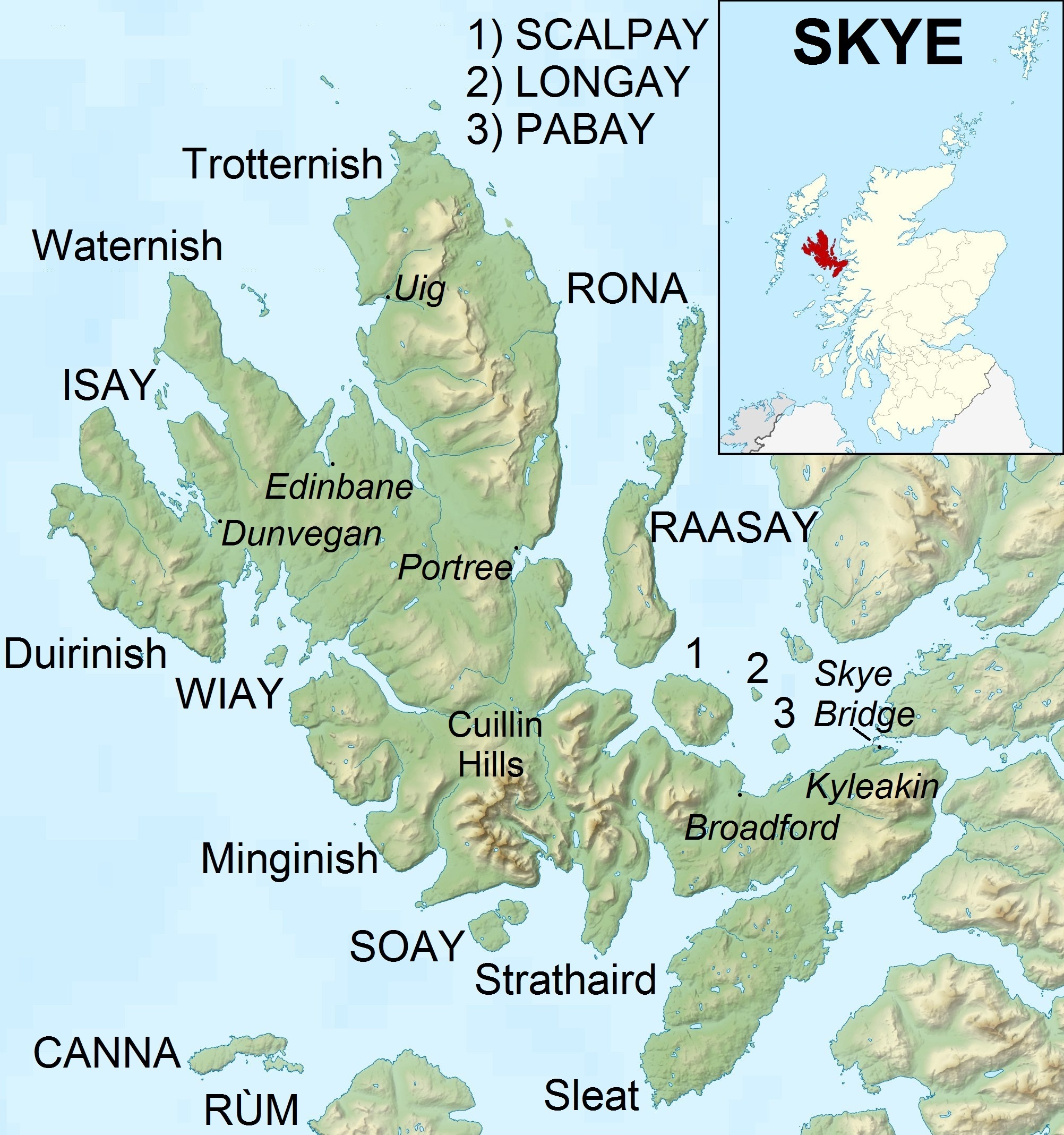
Map showing the location of Soay. It is a small island directly south of the Cullin Hills on the Isle of Skye

It is populated almost exclusively by a feral, and very old breed of sheep, imaginatively named the Soay.


 Photograph showing three soay sheep on a steep hillside with the sea in the background

As my dear friend the Goat Lady has pointed out: Soay is a bit of a bitch to get on to. It's surrounded on almost all sides by large sea cliffs and the interior isn't much better. This means the soay is actually very beneficial to the ecology of the island, since they are able to get to ledges that modern domesticated sheep cannot reach, but this very feature makes it not a good place to retrieve your sheep from when you want to milk them, or shear them or harvest some of the lambs. Soay is also not the place where sheep evolved (this was probably somewhere near Mesopotamia. Certainly that's where we think they were first domesticated). So just how- and why- did the sheep get to Soay?   

Sheep can swim, but not very well, or very far. Therefore, I am going to go out on a limb and say it is unlikely they swam across from Skye itself. That leaves the possibility that people brought them there in boats. It was the Neolithic at the time, so we're talking small boats, but also small sheep. We've already mentioned how difficult it would be to retrieve your herd from the island, so I suppose that leaves us with two options:

1. The sheep were introduced deliberately, and when the time came to collect them, not all could be retrieved. The remaining few formed a population which has continued down to the present day. 

2. The sheep were introduced by accident, perhaps through a mistaken landing or a shipwreck. 

The former seems to me to be untestable. We can rely on common sense, and point to the difficulty of landing, the difficulty of collecting the sheep for herd maintenance, and so on. But it's hard to be exactly sure of what was going on. Perhaps someone was willing to risk losing some sheep to the landscape if that meant they could protect the rest from raids. Maybe someone young and foolish thought they knew best, and it turned out they didn't. People do irrational, illogical things all the time, and that's sort of that. 

Option two seems rather more interesting. Another friend of mine said they reckoned it wouldn't be a shipwreck, because where on earth would you be sailing to? We can't track the movement of specific populations of sheep in the Neolithic (Well, I can't for you right now. A large scale stable isotope analysis study on caprinae (sheep and goat) bones from the Neolithic would sort it out, but until I a) am a much better scientist and b) get a wacking great grant from the European Union, it ain't going to happen). What we can do is consider other artefacts as a proxy for movement, while bearing in mind that moving small objects like handaxes was much easier than moving animals. 

Arran Pitchstone:

Map of Scotland showing distribution of Arran pitchstone. Skye and Soay are well within the zone
Distribution man showing main areas of Arran pitchstone finds (note Skye, and therefore Soay) well inside the zone. Black circles mark large numbers of finds


Rhum Bloodstone:


Distribution map showing locations of Rhum bloodstone from other islands and the mainland. Soay does not have finds, but Skye has several
Distribution map after Wickham-Jones 1990

It's reasonably clear, then, that people did move goods across long distances, including sea distances, during the Neolithic. A consequent movement of people, their livelihoods, ideas and goods is not unexpected. Since we know that sheep had to be transported to Britain somehow- and indeed, across Europe- it is not unreasonable to assume that they too may have been traded, raided, given as kin-gifts, or part of pretty much any other mechanism of exchange you can think of. Given the clear sea connections existing between the islands, and given the fact that sheep must have been transported by sea at some point, it seems not at all unreasonable to me that they might have been the victims of a shipwreck, on soay. 

All we've done here is establish the possible of course. One would need stable isotope analysis of the oldest bones on  the island for that, and it may well still not give us the definitive answer. Archaeology's a bit of a bitch like that.  


Burns Throughout History #9

I've just finished reading R.G. Collingwood's general book on Roman Britain from 1924. As you might expect, it is by turns laughably out of date, horribly racist, and then weirdly prescient of stuff we thought we came up with in the 1990s. This has been my experience of reading almost any academic work from before 1940. At this point, he has been describing the development of Romano-British art forms, and states that this kind of art hybridisation happened all over the empire, which apparently was unpopular with at least one of his colleagues:

"Anyone who wishes to convince himself of its [the idea that hybridisation did not happen] falsehood as applied to the Empire in general need only examine photographs of a representative series of provincial sculptures, that is, if he has an eye for sculpture, which perhaps some historians have npt"

...burn

Sunday, 11 March 2012

Inconspicuous?

This week I thought I'd continue with the theme of archaeology, and discuss barrows.

What are Barrows?

Simply put, barrows are burial mounds. They are generally not infested with wights, as in Lord of the Rings, or walking skeletons as in Skyrim. They are also much smaller than these things portray them; the Skyrim barrows look far more like catacombs than actual barrows.

West Kennet Long Barrow, in the Avebury region. There are a couple of people in this picture, but they're so small you can hardly see them. For scale, those stones at the front are all taller than a human.

Barrows usually, but not always contain burials. These can be of one person, or many people, with wealthy grave goods, or no individual markers at all.

The term 'barrow' applies right the way through from the Neolithic long barrows (above), to Bronze age round barrows (below), to Saxon barrows. That's a period of over 4000 years, so naturally they would have meant many different things in different times. 'Barrow' would not have been the builder's name for them: it's more a classification name, such as 'temple'. Synagogues, churches, mosques and so on could all be called temples, though they all mean something a little different both to believers and non-believers; the same kind of thing applies to barrows, though the different traditions were not concurrent.


Bronze age round barrows from near Stonehenge

 As you can see from the two pictured examples, barrow shape and size are very variable. Many barrows were ploughed out by intensive agriculture, but those that remain are now protected, which is why these look like bright green acne in the middle of all that nice farmland.


What are they for?

Barrows were for burying the dead. In the Neolithic, that meant putting a select group of people in the tomb, generation after generation. Once the bodies had rotted a bit, you swept them back towards the sides of the rooms, and put more bodies in. In some long barrows, the bones have been carefully sorted, and in others they're a bit of a jumble. Often recognisable bones such as skulls or long bones were removed, either for reburial elsewhere, or some kind of ritual.

Bronze age barrows are a bit different. They usually had just one burial, and the monument seems to have been raised specifically to hold them. The body was often laid out ceremonially, with many grave goods. We don't really know what these goods were for; whether votive deposits (gifts for the gods), gifts for the dead, items for use in the afterlife or some other purpose. They were often in use for only one generation or so.


Inconspicuous Barrows

But barrows are big, imposing, in-your-face, right? How can a barrow be inconspicuous?

It turns out that there is another class of barrow from the Bronze age. These are usually found near normal barrow clusters, but are tiny. According to one of my lecturers, you pretty much only spot one as you drive over it in your excavation land rover.

See that tiny lump these people are standing on? That is an inconspicuous barrow.

Inconspicuous barrows are used for a much longer amount of time. Most large barrows seem to be built, used an abandoned within a few decades. The smaller barrows tend to continue to have deposits placed in them for decades or centuries.

As a tradition, they also continue to be built for longer, and are seemingly less of a thing than large barrows. By the end of the barrow-building period, many large barrow groups have been almost segregated. There are big patches of unbuilt on earth and unfarmed land around them, as if there is something taboo about their presence. Other times, people have enclosed them in small ditches, to 'fence them off' from the normal world. In contrast, inconspicuous barrows are just built around, either non threatening or ignored.

So who were these builders? The Methodists of the Bronze age world? Does this difference in barrows imply a different religious practise, with different beliefs and customs (even a different culture), or are they two traditions from the same belief system, concordant rather than competing?

To link back to the Stonehenge post, we just don't know!

Wednesday, 22 February 2012

Stonehenge

We've all seen Stonehenge, if not in real life, then in pictures. It's a symbol of Britain, and a symbol of Prehistory.  I went for the first time ever last week, which is pretty poor, given that I'm an archaeology student within an hour's drive, but I digress.

Stonehenge, showing one of the 'gallows-like' structures

Stonehenge has been the subject of hundreds of books and papers, thousands of hours of arguments and even some legal cases have been about it. So what's going on here? And why do people care so much?


What's in a name?

Why is Stonehenge called 'Stonehenge'? Like almost everything else about it, Stonehenge's name is a little ambiguous. Almost all of the etymologies suggest it derives from the Old English stan meaning 'stone'. The 'henge' may come from hencg meaning 'hinge', or hencen meaning 'gallows' or 'hanging place'. It is not clear if they were actually using the stones to hang people from, or whether they simply thought that the stones resembled a gallows.

Archaeology took the word 'henge', and used it to define a monument that is circular or ovular, with a ditch and bank structure, and the ditch on the inside, the opposite of a defencive structure. All well and good; we needed a word to describe those pesky circles. Except... Stonehenge doesn't have an internal ditch, and it's bank is pretty pathetic: only about 1m high. So actually, it's not a henge.
Avebury, which has an actual henge surrounding the stone circles.

It's also, and this is the mind blowing part, not made of stone.

Okay, it is actually stone, but it almost certainly symbolically represents wood, rather than stone. It doesn't look like any other stone circle. Normal stone circles do not have connecting stones on top of the uprights, but this is thought to have been very common in timber circles.  Below is a picture of the Stones of Stenness, a 'more typical' stone circle, and a reconstruction of a timber circle.

 
 Which one looks more like Stonehenge?


The way the lintel (top) stones are attached is also by a method far more suited to woodworking than stone building. Above is a close up of one of the standing stones. See the little bump on the top? That's to attach the lintel stone, which would have a corresponding hole gouged into it. This is still used in Ikea furniture.

Archaeologists have started to think about Stonehenge in the context of timber, rather than stone circles. A good place to start, if you're interested, is Stonehenge and other Timber Circles by Alex Gibson.


Who built Stonehenge?

A wizard did it. No, really. Geoffrey of Monmouth in the 12th Century wrote an account of the building of Stonehenge. By Merlin.


Not that Merlin. The proper one. Here's a picture of him directing some giants to help him build Stonehenge.

This is the oldest known depiction of Stonehenge. 


A bit later on, in the 1600s, a man called William Stukeley had some other ideas about Stonehenge. Stukeley was one of the most important fore-runners to modern archaeology, who drew some brilliant pictures of the monuments, and did quite a bit of 'excavating'. This was closer to Time Team's methods than a real archaeological enquiry, but pioneering for the time. He was also one of the first biographers of Newton, who was a personal friend. Stukeley suggested that it might have been built by the Druids. This isn't as mad as it first sounds: he identified the building as ritualistic in nature, and then looked for a corresponding 'Priestly-caste' in the ancient sources for a people who had lived here before the Romans. The priests he found were the Druids. Druids became quite popular at one time as folk heroes: those Celtic people who had fought the Romans. This was important, because most of the folk heroes of the individual countries of Great Britain were heroes for killing the others. Usually the English.

More recently, thanks to various dating methods, it has become clear that Stonehenge is much, much older than the Druids.* They existed about 2000 years ago, all across Western Europe. By AD86 they had been herded across Europe by the Romans. Agricola, the governor of Britain cornered the last of them on Anglesy and had them all killed.

However, Stonehenge had been built long before that, from about 3100BC - 1600BC, in a series of very distinct phases. Clearly the place was important, but it's meaning would almost certainly have changed over that time. Since we think the average life expectancy was about 30,  that's 3 generations a century, or 45 generations in total. That's more than the generations between our time and the time of Jesus.


What does  it mean?

No one knows. Is it, as Mike Parker Pearson has suggested, a place that represents death? Would people have processed from Woodhenge (a timber circle), the symbolic place of life to Stonehenge, the symbolic counterpart?  Or does it represent life, as a timber circle, immortalised forever as durable stone? Is it a landing place for aliens, an inter dimensional portal, a prehistoric computer?

Jaquetta Hawkes said that 'Every generation gets the Stonehenge it deserves', by which she meant that each new group of archaeologists has a new take on the meaning of the monument, usually at least in part driven by their own ideas about the world.

What Stonehenge meant to the people who built it is likely to be something archaeologists argue about forever, and probably something we will never really know. However, Stonehenge is more than just a dead monument; it has meaning to people in the here and now. In that case, Stonehenge can mean anything you want it to; Stonehenge can be all things to all people, as long as they don't extrapolate that back onto those in the past.

*Note: the Neo-Druids contest this; they continue to believe that Stonehenge was built by Druids.